


What scientific studies and experts tell us about the long-term effects of contaminants present in our environment, and why water quality deserves our full attention.
Every day, we drink water without giving it a second thought.
It goes with our meals, our exercise, our sleep, our concentration. It's one of the most constant parts of everyday life.
But when it comes to water quality, one question is rarely asked: what are the real effects of repeated exposure to certain contaminants on our health?
PFAS, cadmium, lead, mercury, perchlorates, microplastics: these substances don't all share the same properties, and they're not all backed by the same level of scientific evidence. Some now have well-established health effects; for others, research is still ongoing.
This is exactly the subject we explored in a podcast bringing together Alexandre Mahe, founder of Sküma Water, and Dr Christian Boyer, a doctor in health biology and an expert in environmental health.
The podcast was hosted by Lucis, a preventive health platform that analyses over 100 blood biomarkers (cardiometabolic health, hormones, inflammation, liver and kidney function) to offer personalised guidance, without replacing medical advice, an approach that ties directly into our subject: better understanding what quietly affects the body over the long term, exactly what is at stake with chronic exposure to pollutants.
So which diseases can genuinely be linked to pollutant exposure? And, more importantly, what do we actually know with enough certainty today?
Water pollution and health: the real issue is usually chronic exposure
Before talking about disease, one distinction matters: acute exposure and chronic exposure don't tell the same story.
Acute exposure means a large amount of a substance absorbed over a short period. This kind of poisoning can cause symptoms quickly, but it remains relatively rare in the general population for the contaminants discussed here.
Chronic exposure is different.
It means low or moderate doses repeated over months, sometimes years. Some substances can then build up in the body or produce long-term biological effects.
This is particularly true of certain heavy metals and PFAS, whose persistence in the environment, and for some of them in the body, is especially concerning.
This doesn't mean someone who drinks tap water will necessarily develop a disease.
It means that assessing health risk can't be reduced to the question “is this water safe to drink?” It also has to factor in exposure levels, duration, and every route of exposure combined.
This is the whole logic behind the exposome: our health is the result of the combination of many environmental exposures over the course of a lifetime.
Cadmium: a heavy metal of particular concern for kidneys and bones
Cadmium is probably one of the clearest examples when discussing chronic exposure.
The UK's Committee on Toxicity (COT), which reviews the Food Standards Agency's ongoing Total Diet Study, running continuously since 1966, has flagged that cadmium intake in young children can approach or exceed EFSA's tolerable weekly intake in some cases: COT data show toddlers aged 1.5 to 3 exceeding the threshold by a small margin, and solid food intake in some 12-to-60-month-olds reaching up to 260% of it. In France, a parallel 2026 assessment by ANSES, the French food and environmental safety agency, found a significant share of the adult population above health reference values, a finding consistent with the pattern COT has tracked in the UK for specific age groups.
Cadmium is particularly recognised for its effects on the kidneys and the skeletal system, and it's classified as carcinogenic, mutagenic and toxic to reproduction.
Dr Christian Boyer makes a point of this in our podcast: among heavy metals, the kidney is a particularly significant target for cadmium.
An important clarification: water isn't the main source of cadmium
This point matters, so we don't fall into the shortcut of “cadmium = contaminated water”.
In non-smokers, diet is the main route of cadmium exposure, well ahead of water. Both COT/FSA data in the UK and EFSA's wider European assessments confirm this: food, cereals, potatoes and shellfish among the main contributors, remains the dominant source for the general population.
Water can nonetheless represent an additional route of exposure when it's contaminated.
This nuance matters: when discussing water pollution, the goal isn't to attribute every health effect of a contaminant to water, but to understand this daily exposure's potential contribution to our overall load.
Lead and mercury: particularly well-documented neurological effects
Lead and mercury are two other heavy metals whose health effects are widely documented.
Lead can affect the nervous system and the blood system in particular. In children, concerns are especially significant because the developing brain is more vulnerable to neurotoxic effects.
Mercury, particularly in its methylmercury form, is also a recognised neurotoxicant, with particular attention paid to exposure during pregnancy and to child development.
Here too, exposure comes from multiple sources: diet, the environment, older materials, or certain occupational activities.
Drinking water is therefore only one piece of the puzzle.
But when a substance can be present in the water we consume daily, the question of its contribution to overall exposure is clearly worth asking.
PFAS: “forever chemicals” whose health effects are now better documented
PFAS occupy a particular place in discussions about water quality today.
This family covers thousands of chemical substances used for decades for their resistance to water, grease and heat.
The problem: many of them are extremely persistent in the environment.
And scientific understanding has advanced considerably in recent years.
In 2023, the International Agency for Research on Cancer (IARC) classified PFOA as carcinogenic to humans (Group 1). PFOS was classified as “possibly carcinogenic to humans” (Group 2B).
PFAS are also studied for their effects on the immune system. In 2020, EFSA identified reduced immune response to vaccination as the critical effect used to set its safety threshold for four major PFAS.
Children are also a particularly exposed group, notably because of their food consumption relative to body weight.
And in drinking water?
In the UK, the Drinking Water Inspectorate (DWI) applies a guideline value of 0.1 µg/L for the sum of 48 monitored PFAS, tightened in August 2024. The UK isn't bound by the EU's equivalent directive, which set its own 0.1 µg/L limit for member states from 12 January 2026, but the two frameworks have arrived at broadly similar thresholds. The UK published its first national PFAS Plan in February 2026, opening a consultation on introducing a full statutory limit rather than a guideline value.
This is a significant change.
It also illustrates something broader: regulation evolves as scientific understanding progresses, in the UK as much as in the EU.
But the thousands of PFAS that exist obviously don't all benefit from the same level of toxicological data.
Microplastics: a scientific question that's still open
Microplastics are probably one of the hardest subjects to interpret today.
They're detected across different environments, including water, but the precise consequences of chronic human exposure remain insufficiently characterised.
Experimental research points to possible mechanisms involving inflammation, oxidative stress, and potential interactions with the gut microbiome. But much of the available data still comes from in vitro or animal studies.
It would therefore be premature to claim that the microplastics found in water cause any specific disease in humans.
That said, their presence and the question of chronic exposure represent a genuine subject for scientific and environmental health research.
It's precisely this distinction, between what's demonstrated, what's likely, and what's still to be established, that allows for a serious conversation about water quality.
Perchlorates: a less well-known example of pollution, but a biologically precise one
Perchlorates get far less media attention than PFAS or microplastics.
Yet their mechanism of action is genuinely interesting: they can interfere with the thyroid's uptake of iodine.
This matters particularly for vulnerable populations, notably infants and pregnant women.
In 2025, several municipalities in the Seine-et-Marne region of France were subject to specific recommendations regarding tap water use for infants, due to perchlorate concentrations exceeding precautionary thresholds. It's a French example rather than a UK one, but the underlying mechanism, and the principle that local, small-scale contamination can still justify targeted monitoring, applies just as well on this side of the Channel.
This case is a useful reminder: a contaminant doesn't need to be present in massive quantities to justify particular monitoring. It all depends on its biological properties, the population exposed, and the duration of exposure.
The real challenge: we're never exposed to just one pollutant
This might be the most complex question of all.
In real life, we're never exposed to a single substance at a time.
We can be simultaneously exposed to heavy metals, PFAS, pesticides, environmental residues, or particles.
Yet toxicology has historically studied most substances one at a time.
EFSA is specifically developing methodologies to better assess combined exposure to multiple chemical substances.
In our podcast, Dr Christian Boyer also points out that this “cocktail effect” remains one of the subjects where scientific knowledge is still most limited.
This doesn't mean all these substances simply add up to cause disease.
It means our real-world exposure is far more complex than the experimental models that study a single substance in isolation.
So, should we be afraid of the water we drink?
No.
And that's probably the most important thing to take away.
Water declared safe to drink meets health and regulatory requirements. The possible presence of trace amounts of a contaminant doesn't automatically mean it's dangerous or that it will cause disease.
The real issue is understanding our daily exposure better.
Water is one exposure route among others. But unlike many other everyday products, it's consumed every day, throughout life.
That's why reducing an avoidable exposure can be a rational, preventive approach, without tipping into fear or an obsessive search for “perfect” water.
A simple question: what can we actually control?
We obviously can't control soil contamination, industrial pollution, or the persistence of PFAS in the environment.
What we can do is ask ourselves about the quality of the water we choose to drink every day.
This is exactly where purification comes in.
At Sküma Water, this approach relies on a multi-step process: purify the water, then remineralise it in a controlled way.
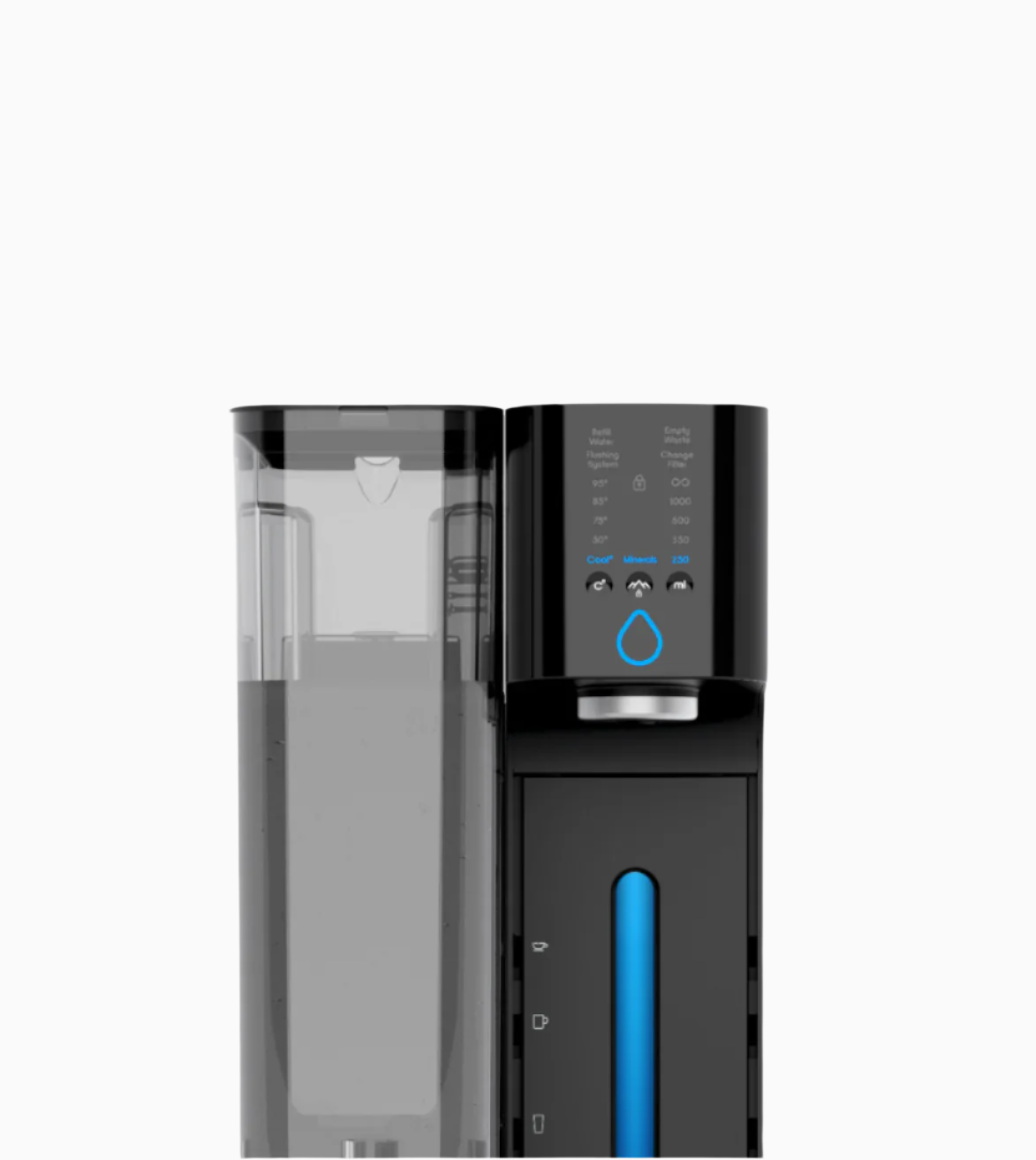
Testing carried out on the MY™ Station's filtration system by an independent COFRAC-accredited laboratory assessed its effectiveness across different families of contaminants, with removal rates above 96% for the heavy metals tested, including cadmium and lead, in line with the performance we detailed in our article on everyday heavy metals. All the pollutants covered in this article, cadmium, lead, mercury, PFAS, perchlorates and microplastics, are among the substances removed by the MY™ Station.
The goal isn't to claim that filtration “prevents disease”.
It reduces certain sources of exposure.
And that distinction matters.
Because the future of hydration might not simply be about drinking more water, but about better understanding what we drink, and reclaiming some control over our daily exposure.
Frequently asked questions
How was the Sküma Super-Filter's performance tested and certified?
The Sküma Super-Filter's performance was assessed and certified in February 2025 by an independent French laboratory accredited by COFRAC.
The tests demonstrated the removal of:
99.9% of water contaminants, including 165 pesticides and their metabolites, 20 PFAS, 14 heavy metals, pharmaceutical residues, volatile organic compounds (VOCs), vinyl chloride monomer (VCM) and perchlorates;
98% of microplastics;
96% of total dissolved solids (TDS);
61% of TFA (trifluoroacetic acid).
To validate these results, Sküma set a particularly demanding test protocol. Over 230 contaminants likely to be present in tap water were selected from Regional Health Agency (ARS) reports and NSF/ANSI standards. The water used for testing was then spiked with these contaminants before being filtered through the Super-Filter, to precisely measure removal rates.
The Super-Filter combines three filtration technologies: a sediment filter, a high-performance activated carbon filter, and a reverse osmosis membrane. In most cases, contaminant concentrations after filtration reach the analytical limit of quantification.
You can view the full results and test reports in the Science section of our website.
Whatever the quality of your tap water, the MY™ Station lets you obtain purified water, then personalised to your preferences.
What are the main water pollutants that can affect health?
Contaminants under significant monitoring and research include PFAS, heavy metals such as lead, mercury and cadmium, pesticides, perchlorates and microplastics. They don't all carry the same level of scientific evidence or the same health risk.
Are PFAS in drinking water dangerous?
Some PFAS are linked to documented health effects. PFOA is classified as carcinogenic to humans by IARC. EFSA also considers reduced immune response to vaccination a critical effect in its assessment of certain PFAS.
Is the cadmium found in water dangerous?
Cadmium is a contaminant of concern, particularly for kidneys and bones, and is classified as carcinogenic. However, diet is the main exposure route for the general non-smoking population, water being only one potential source among others.
Do microplastics in water cause disease?
Current scientific data doesn't yet allow precise conclusions about which diseases, if any, microplastics in water might cause in humans. Potential mechanisms involving inflammation and oxidative stress are being studied, but more research is needed.
Can water pollutants be removed from drinking water?
Certain treatment technologies can substantially reduce specific families of contaminants. Their effectiveness depends on the technology used and the substance targeted. Filtration shouldn't be presented as a universal solution.
What to remember
Water pollutants shouldn't be ignored, nor should they become a source of anxiety.
The subject is more nuanced: some substances now have well-documented health effects, while others remain the subject of ongoing research. And our exposure never comes from a single source.
Water is simply one of the everyday exposures we can better understand and, in some cases, better manage.
This is the logic behind Sküma Water's approach to hydration: more transparent, more controlled, and grounded in understanding what we drink.
Because knowledge shouldn't create fear.
It should give us more power over our everyday choices.