


The short answer: in an independent laboratory test, the Sküma® Super-Filter removed up to 99.9% of 229 contaminants added to tap water, including 20 PFAS, 165 pesticides and their metabolites, and 14 heavy metals. The lab measured every one before and after filtering, and we publish every result.
Here is where those contaminants come from, how the test worked, what it found, and how it compares with the standards other filters quote.
Where do contaminants in tap water come from?
Contaminants can enter tap water at four points. At the source, rain washes farm pesticides and industrial chemicals into rivers and groundwater. Treatment adds disinfection by-products. Old pipes in the network can release vinyl chloride, and lead can come from the pipes and solder inside older homes.
| Where | What can get in | Example |
|---|---|---|
| The source | Pesticides and their metabolites, PFAS, TFA, nitrates | A chlorothalonil metabolite was found in more than half of French drinking water samples (ANSES, 2023) |
| Treatment | Disinfection by-products such as chloroform and trihalomethanes | Formed when chlorine meets natural organic matter |
| The network | Vinyl chloride from PVC pipes laid before about 1980 | Worst in rural France, where water stands longest in the pipes (Politis, 2025) |
| The last metres | Lead from supply pipes and solder | 53 lead failures in 13,394 samples in England in 2024 (DWI) |
The last metres are the part water companies do not own. In England, the Drinking Water Inspectorate (DWI) notes that lead supply pipes inside a property belong to the homeowner, and that some lead pipes remain on the final sections of company networks that supply homes.
In short: water leaves the treatment works tested, but it can still change before it reaches your tap.
Inside Sküma's independent lab test
In February 2025, an independent French laboratory accredited by COFRAC took tap water, deliberately added 229 contaminants to it, and measured their levels. It then passed the water through a new Sküma® Super-Filter and measured the same contaminants again. Comparing the two results gives the share each contaminant was reduced by.
Many contaminants were added at levels well above the legal limits for drinking water, so the filter was tested against far more than ordinary tap water would carry. The water held 58 µg of lead and 56 µg of arsenic per litre, against an EU limit of 10 µg for each, and 380 mg of nitrates per litre, against a limit of 50 mg, under the EU Drinking Water Directive. After filtering, lead was below 0.4 µg and arsenic below 0.2 µg per litre.
Many results after filtering were below the lowest level the lab's equipment can detect, so the reductions shown are the most the method can measure, and the true figures may be higher. The test used a new filter, so it shows how the Super-Filter performs from the day it is fitted.
Verdict: a before-and-after test against 229 contaminants, run by an accredited lab, with every result published.
What did the lab test for?
The lab tested the Super-Filter against 229 contaminants likely to be found in tap water, chosen from reports by France's regional health agencies (ARS) and from the NSF/ANSI standards used to certify filters. They span every point in the table above, from farm pesticides to the lead in old plumbing.
| Contaminant | Before filtering | After filtering | Removed |
|---|---|---|---|
| Heavy metals (14, including lead and arsenic) | 253 µg/L | <3.2 µg/L | 98.7 to 99.9% |
| Sum of 20 PFAS | Not shown | <0.056 µg/L | 99.9% |
| TFA (trifluoroacetic acid) | 0.9 µg/L | <0.35 µg/L | 61% |
| 165 pesticides | 1.386 µg/L | 0.022 µg/L | 98.3 to 99.9% |
| Pesticide metabolites (6) | 0.263 µg/L | <0.027 µg/L | 89.9 to 99.9% |
| Microplastics | 316 particles | 6 particles | 98.1% |
| Nitrates | 380 mg/L | 30 mg/L | 92% |
| Sulphates | 17 mg/L | <2.5 mg/L | 85.3 to 99.9% |
| Chlorides | 22 mg/L | <1 mg/L | 95.5 to 99.9% |
| Fluoride | 0.59 mg/L | <0.1 mg/L | 83.1 to 99.9% |
| Vinyl chloride | 0.2 µg/L | <0.1 µg/L | 55 to 99.9% |
| Perchlorates | 10 µg/L | <0.1 µg/L | 90 to 99.9% |
| Volatile organic compounds | 0.28 µg/L | <0.13 µg/L | 53.9 to 99.9% |
| Drug residues | 0.025 µg/L | <0.004 µg/L | 86 to 99.9% |
| Total chlorine | 0.08 mg/L | <0.04 mg/L | 99.9% |
| Total hardness | 315 ppm | 14 ppm | 96% |
Results from the independent laboratory test, February 2025, as published on the Sküma® Science page. A "<" value is below what the test equipment can detect.
In short: 229 contaminants, from every stage of the journey, each measured before and after.
Why did we test for 20 PFAS?
We tested for 20 PFAS because that is the list EU law regulates. Since 12 January 2026, the EU Drinking Water Directive has limited the sum of 20 named PFAS to 0.1 µg per litre in every member state. In the test, the Super-Filter reduced the sum of all 20 by 99.9%.
The UK has gone further on monitoring. Since March 2025, the Drinking Water Inspectorate's guidance asks water companies in England and Wales to keep the sum of 48 named PFAS below 0.1 µg per litre. The US standards most filters are certified to cover fewer: the PFAS claim in NSF/ANSI 53 and 58 has covered 7 compounds since 2022, according to WaterWorld.
In short: 20 PFAS is the EU's legal list, nearly three times the 7 the US filter standards cover.
What is TFA, and why is it so hard to remove?
TFA, or trifluoroacetic acid, is the smallest of the "forever chemicals", one of the most widespread, and not one of the EU's 20 PFAS. A national study by ANSES, France's food and health safety agency, found TFA in 92% of drinking water samples, at an average of 1.15 µg per litre, as UFC-Que Choisir reported in December 2025.
TFA is so small that most treatment cannot catch it. The German water technology centre TZW reports that activated carbon, ozone and chlorination are practically ineffective against it, and that reverse osmosis is the only treatment that removes it. In our test, the Super-Filter reduced TFA from 0.9 to below 0.35 µg per litre, a reduction of 61%.
In short: TFA is everywhere and hard to filter; reverse osmosis is one of the few ways to reduce it.
Why test pesticide metabolites as well as pesticides?
Pesticide metabolites are what a pesticide breaks down into in soil and water, and they are often found more widely than the pesticide itself. In its 2023 national campaign, ANSES found a metabolite of the fungicide chlorothalonil in more than half of French drinking water samples, and above the 0.1 µg per litre quality limit in more than one in three.
That is why the test covered 165 pesticides and plant protection products, from triazines to carbamates, and their metabolites. The Super-Filter reduced pesticides by 98.3 to 99.9%, and metabolites by 89.9 to 99.9%.
In short: testing metabolites covers what is actually in the water, not only what was sprayed.
What about lead, vinyl chloride and other contaminants from pipes?
Contaminants that enter in the network or in your home arrive after the water has been treated, so a filter at the tap is the last point to catch them. The Super-Filter reduced lead from 58 to below 0.4 µg per litre, more than 99.9%. Vinyl chloride, which can leach from older PVC pipes, fell from 0.2 to below 0.1 µg per litre, the lowest level the test could detect.
The test also measured the by-products of chlorine treatment. Total trihalomethanes fell from 7.45 to below 0.6 µg per litre, a reduction of 92 to 99.9%.
In short: a filter at the tap catches what the pipes add after treatment.
How does this compare with the standard tests filters quote?
Most filters quote certification to one or more NSF/ANSI standards, which test a set list of contaminants. NSF/ANSI 58, the standard for reverse osmosis systems, requires a reduction in total dissolved solids, and a filter can then add optional claims from a list of 17, such as lead, arsenic and fluoride, according to NSF.
| Test | What it covers | PFAS covered |
|---|---|---|
| NSF/ANSI 58 | Total dissolved solids, plus a list of 17 optional claims | 7 |
| NSF/ANSI 401 | Up to 15 emerging contaminants, such as medicines and pesticides | None listed |
| Sküma® laboratory test | 229 contaminants, every result published | 20, plus TFA |
NSF/ANSI 401 scope as described by NSF. Certification also covers the safety of materials and structural strength; our test measures contaminant removal.
In short: a standard test checks a short list; our test measured 229 contaminants and shows every result.
Does reverse osmosis remove minerals too?
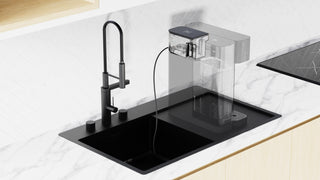
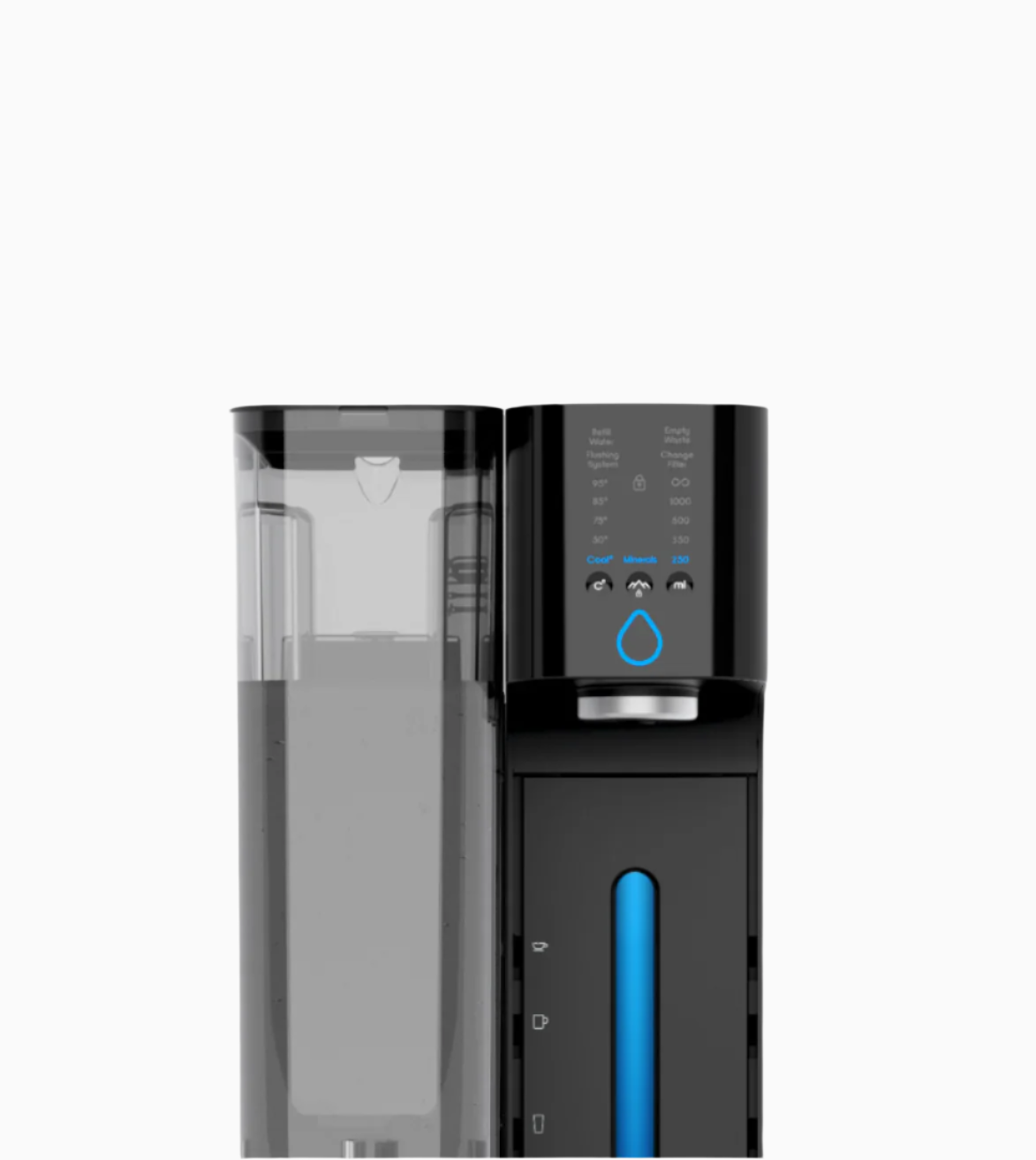
Yes. Reverse osmosis removes minerals along with contaminants: in the test, total hardness fell from 315 to 14 ppm. That is why the Sküma® MY™ Station adds them back. Water passes through the Super-Filter's three stages, a sediment filter, activated carbon and a reverse osmosis membrane, then MY™ Bases add your preferred mineral profile back into your water. It sits on the counter, with no plumbing, and gives you hot water on demand too.
In short: purify first, then add back the minerals you choose.
What to remember
Tap water can pick up contaminants at the source, during treatment, in the pipes and in the last metres into your home. An independent COFRAC-accredited laboratory added 229 of them to tap water, from 20 PFAS and TFA to 165 pesticides, their metabolites and 14 heavy metals, and measured them before and after a new Sküma® Super-Filter. It removed up to 99.9%, and every result is on our Science page.
FAQ: Sküma's laboratory test results
What contaminants does the Sküma® Super-Filter remove?
In an independent laboratory test in February 2025, it reduced 229 contaminants added to tap water by up to 99.9%, including 20 PFAS, 165 pesticides and their metabolites, 14 heavy metals, microplastics, nitrates, fluoride, vinyl chloride and chlorine by-products.
Does the Sküma® Super-Filter remove PFAS?
Yes. In the test, it reduced the sum of the 20 PFAS regulated under the EU Drinking Water Directive by 99.9%. It reduced TFA, the smallest PFAS, by 61%.
What is TFA?
TFA, or trifluoroacetic acid, is the smallest of the "forever chemicals". ANSES found it in 92% of French drinking water samples. Activated carbon barely removes it, and reverse osmosis is the main treatment that does.
Why test 20 PFAS?
The EU Drinking Water Directive limits the sum of 20 named PFAS to 0.1 µg per litre from 12 January 2026. The PFAS claim in the US NSF/ANSI 53 and 58 standards covers 7. In England and Wales, guidance asks water companies to monitor 48.
Does the Sküma® Super-Filter remove lead?
Yes. In the test, it reduced lead from 58 µg per litre, well above the EU limit of 10, to below 0.4 µg per litre, a reduction of more than 99.9%.
Does it remove microplastics?
Yes. In the test, microplastics fell from 316 particles to 6, a reduction of 98.1%.
Who tested the Sküma® Super-Filter?
An independent French laboratory accredited by COFRAC, France's national accreditation body, tested it in February 2025. Accreditation means the laboratory's methods and competence have been checked against international standards.
Where can I see the full results?
Every result, contaminant by contaminant, is on the Sküma® Science page.
Sources: Sküma® independent laboratory test, COFRAC-accredited laboratory (2025), and Science page (2026); ANSES, emerging pollutants in drinking water (2023); UFC-Que Choisir on the ANSES TFA study (2025); TZW, TFA-Trink; EU Drinking Water Directive 2020/2184 and Normec (2026); Drinking Water Inspectorate, PFAS guidance (2025) and Drinking Water 2024 (2025); Politis (2025); NSF, NSF/ANSI 58 and NSF/ANSI 401 (2026); WaterWorld (2023). Last updated: 04/11/2026.
Note: this article is for information purposes and does not replace medical advice.