


Cadmium, mercury, lead: these heavy metals don't reach your body through some isolated industrial accident. They come from ordinary, everyday sources, whether you live alone or with a family: a square of chocolate, a tin of tuna, the water coming out of your pipes. Here's where these exposures actually come from, what the science says about each one, and why the one lever you can genuinely pull sits at your tap.
Cocoa, a natural source of cadmium
The cadmium found in chocolate isn't an industrial additive: cacao trees absorb it directly from the soil through their roots. Latin America's volcanic soils (Ecuador, Peru, Colombia) naturally contain more of it than West Africa's, which nonetheless supplies over 60% of global production. The higher the cocoa content, the higher the cadmium concentration tends to be, which puts dark chocolate at the top of the exposure list.
The UK retains the EU's maximum levels for cadmium in chocolate, ranging from 0.1 to 0.8 mg/kg depending on cocoa content, in force since January 2019. Food Standards Scotland testing of supermarket dark chocolate has found measurable cadmium in the majority of samples, generally within the legal limit but rarely at zero. Cadmium is classified as a Group 1 human carcinogen by the International Agency for Research on Cancer, and it accumulates in the kidneys and liver over decades before being cleared.
Fish, the main source of mercury
Almost all dietary mercury exposure comes from eating fish, in its most toxic form, methylmercury. Predatory fish concentrate the most of it: tuna, swordfish, shark and marlin, due to their position at the top of the food chain. The UK enforces maximum levels of 1.0 mg/kg for tuna and 0.5 mg/kg for most other fish.
The Food Standards Agency addressed the topic directly in late 2024, after a report from the French marine conservation group BLOOM put tinned tuna's mercury content back in the headlines. The FSA and NHS advise pregnant women, those trying to conceive and breastfeeding mothers to cap tuna at four medium tins or two fresh steaks a week, and to avoid shark, swordfish and marlin entirely, a rule that also applies to children. For everyone else, the NHS recommends at least two portions of fish a week including one oily portion, with women of childbearing age capped at two oily portions and men up to four.
Lead, inherited from old pipework
Before 1970, lead pipework was the standard way of connecting UK properties to the mains. Its use has since been banned, but the Drinking Water Inspectorate estimates around 8.9 million homes in England and Wales still have lead water supply pipes, mostly in older, unmodernised properties.
The current legal limit is 10 µg/L, though a DWI advisory group recommended tightening this to 5 µg/L in December 2024, and UK water companies have collectively set an ambition to be lead-pipe-free by 2050. The World Health Organization goes further: it states there is no safe level of lead in drinking water. The risk depends heavily on how long water has been standing in the pipe, whether overnight, after a day out, or after time away, so the advice is the same whether you live alone in an old flat or as a family in a Victorian terrace: run the tap for a minute or two before drinking or cooking with water that's been sitting.
Switching your hot water cylinder back on, an underrated risk
A less well-known mechanism: restarting a hot water cylinder that's been sitting unused for days or weeks. The tank, especially once its sacrificial anode has worn down, can develop rust and corrosion deposits during that inactivity. The result is brownish or metallic-tasting water on the first draw, carrying particles of iron and other metals released by internal corrosion, a well-documented issue among plumbing professionals, particularly after a period away from home.
Molybdenum, the essential-metal paradox
Less talked about than lead or mercury, molybdenum is an unusual case: it's an essential trace element, required for several enzymes to function, yet toxic beyond a certain threshold. The World Health Organization has set a health-based guideline value of 70 µg/L for drinking water, while the US Environmental Protection Agency uses a lifetime health advisory of 40 µg/L. Natural concentrations in water are usually very low (1 to 2 µg/L), but can rise sharply near mining or industrial activity. Excess exposure has been linked to gout-like symptoms from elevated uric acid, along with liver and kidney effects.
What you don't control, and what you do
The common thread across these sources: individually, you have almost no control over them. Chocolate is everywhere, including in a balanced diet. Fish is part of official nutritional guidance. The pipework in your home, rented or owned, old or new, isn't something you can decide on, whether you live alone or with others. You can't choose where cacao trees grow, and you can't rewire your building's plumbing.
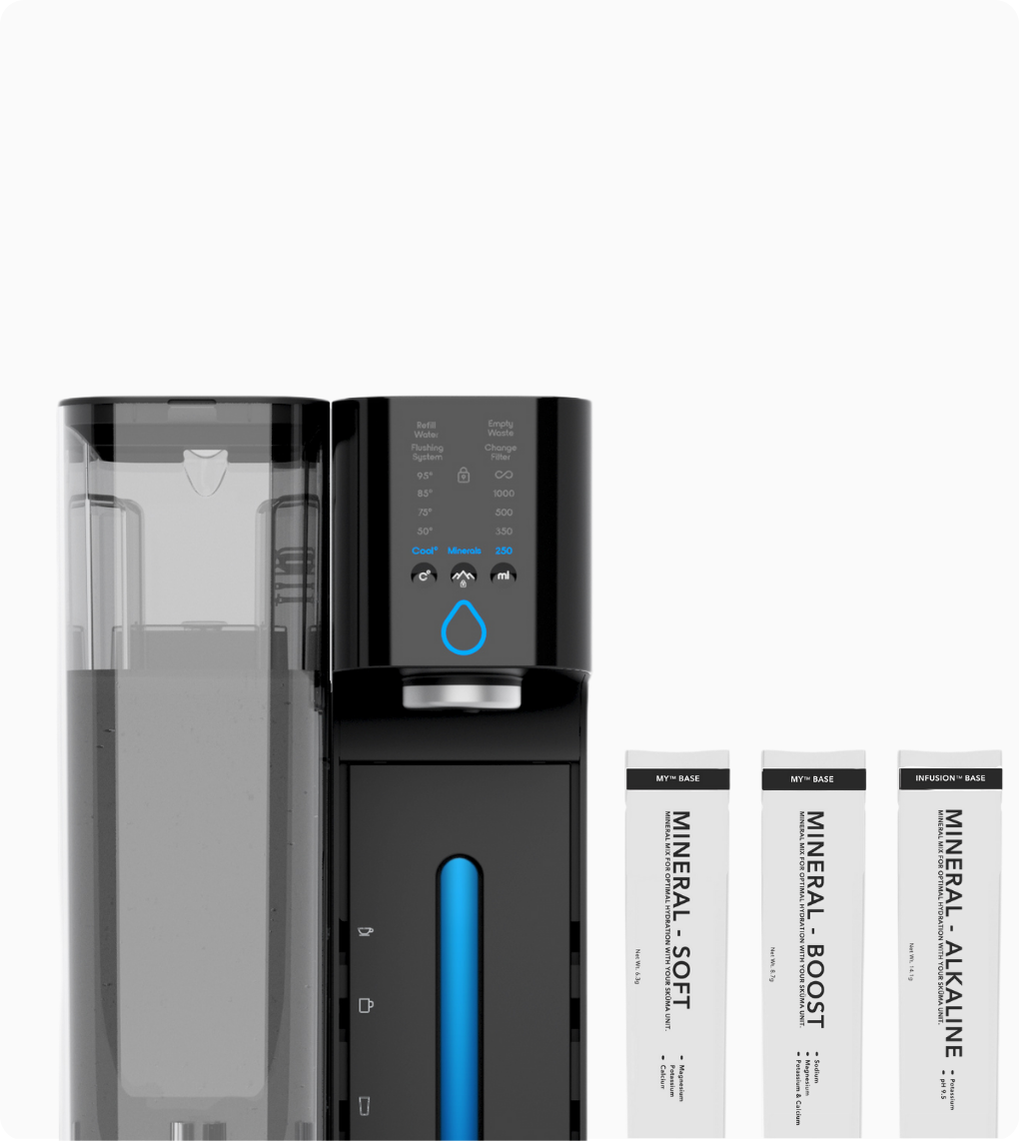
What you can control is what's left in your water by the time you drink it. A COFRAC-accredited lab test on the MY™ Station shows the following removal rates:
|
Metal |
Before (µg/L) |
After (µg/L) |
Removal |
|
Heavy metals (total) |
253 |
<3.2 |
96.7 to 99.9% |
|
Aluminium |
590 |
<20 |
97 to 99.9% |
|
Arsenic |
56 |
<0.2 |
>99.9% |
|
Manganese |
570 |
<6 |
>99.9% |
|
Barium |
0.61 |
<0.02 |
97 to 99.9% |
|
Cadmium |
5.9 |
<0.03 |
>99.9% |
|
Chromium |
58 |
<1 |
98 to 99.9% |
|
Copper |
0.09 |
<0.01 |
90 to 99.9% |
|
Iron |
570 |
<10 |
98 to 99.9% |
|
Mercury |
0.8 |
<0.015 |
98 to 99.9% |
|
Nickel |
58 |
<1 |
98 to 99.9% |
|
Lead |
58 |
<0.4 |
>99.9% |
|
Selenium |
64 |
<0.5 |
>99.9% |
|
Zinc |
0.07 |
<0.01 |
86 to 99.9% |
|
Molybdenum |
460 |
<20 |
95 to 99.9% |
Cadmium, mercury, lead and molybdenum come out almost undetectable at the MY™ Station's outlet. You don't control what the world puts into your food, you control what you let into your water.
Frequently asked questions
Can you eliminate heavy metals from your diet entirely?
No, cocoa and fish contain them naturally. Water is the one area where a near-total, lab-verifiable reduction is achievable.
Does the MY™ Station remove molybdenum?
Yes, between 95 and 99.9% confirmed by COFRAC testing.
Should you stop eating chocolate or fish?
No. The FSA and NHS recommend varying species and moderating intake rather than cutting them out, both are foods with genuine nutritional value.
Sources
Food Standards Agency, “Should we be concerned about mercury in tinned tuna?”, November 2024
NHS, fish and shellfish consumption guidance
Food Standards Scotland, testing data on cadmium and lead in supermarket chocolate products
Retained EU Regulation 1881/2006 (as amended), maximum levels for cadmium in cocoa and chocolate products
International Agency for Research on Cancer (IARC), cadmium classification, Group 1
Drinking Water Inspectorate (DWI), Lead in Drinking Water guidance, and December 2024 advisory group recommendations
World Health Organization (WHO), Guidelines for Drinking-water Quality (lead, molybdenum)
US EPA, Lifetime Health Advisory for Molybdenum
COFRAC-accredited lab report E25-05401, MY™ Station, Sküma Water
Note: the removal rates shown come from COFRAC-accredited lab testing on the MY™ Station. The regulatory thresholds cited (UK, WHO, EPA) relate to overall dietary exposure, not water alone.