


Which should you choose between an activated carbon filter and a reverse osmosis system? The answer mostly depends on what you're actually trying to remove from your water.
The two technologies are often presented as alternatives to one another. Yet they don't work the same way, don't target the same substances, and don't produce quite the same kind of water.
Activated carbon is particularly good at improving the taste and smell of water and reducing certain chemical substances, notably chlorine and certain organic compounds. Reverse osmosis, meanwhile, uses a semi-permeable membrane under pressure to reduce a much wider range of dissolved substances, including salts, nitrates, certain metals and many persistent contaminants.
But that capability comes with an important consequence: reverse osmosis also significantly reduces the minerals naturally present in water.
That's a characteristic of the process, not a manufacturing flaw. And it's precisely why a remineralisation step can make a lot of sense after reverse osmosis.
So how do these two technologies actually work? What does activated carbon remove? What does reverse osmosis remove? What happens to the minerals? And why do some machines combine both?
That's exactly what we're going to look at.
Activated carbon or reverse osmosis: what's the fundamental difference?
Before comparing their performance, it's worth understanding that an activated carbon filter and a reverse osmosis membrane don't work on the same principle at all.
Activated carbon works through adsorption
Activated carbon is an extremely porous material. Its processing dramatically increases its internal surface area, which allows it to trap certain molecules on its surface.
This phenomenon is called adsorption.
As water passes through activated carbon, some substances have a strong enough affinity with its surface to get trapped there. Others pass straight through the filter.
This is notably what explains its effectiveness against chlorine, certain volatile organic compounds, the molecules responsible for certain tastes and smells, and, depending on the type of carbon and the operating conditions, certain PFAS.
Activated carbon is therefore very useful when you're trying to target specific families of contaminants.
But it shouldn't be treated as a universal filter.
Reverse osmosis uses a semi-permeable membrane
Reverse osmosis relies on a very different mechanism.
Water is pushed under pressure through an extremely fine membrane. Part of the water passes through this membrane: that's the permeate. Another part, more concentrated in retained substances, is discharged as concentrate or reject water.
A reverse osmosis membrane therefore acts as a much more general barrier against many dissolved substances.
Reverse osmosis systems can notably reduce dissolved salts, sodium, nitrates, certain metals, fluoride, sulphate, calcium, magnesium and various organic contaminants. They can also act as a barrier against many microorganisms.
But here too, it's worth avoiding an overly simple formulation: reverse osmosis doesn't remove absolutely everything, at 100%, under all conditions. Performance depends on the membrane, the pressure, the quality of the incoming water, the flow rate and the system's overall design.
That's why serious manufacturers give performance figures per contaminant rather than a vague promise of total purification.
What does an activated carbon filter really remove?
Activated carbon is one of the oldest and most widely used water treatment technologies.
It's found in filter jugs, under-sink filters, certain domestic filtration systems and many water treatment processes.
Its main value lies in its ability to adsorb certain molecules.
Activated carbon is particularly good for:
• chlorine;
• certain volatile organic compounds;
• certain molecules responsible for taste and odour;
• certain pesticides and organic compounds, depending on their structure;
• certain PFAS, with effectiveness that depends notably on their structure, the type of carbon and the contact time.
This is notably why activated carbon filters can considerably improve the taste of tap water.
The CDC notes, moreover, that activated carbon filters are mainly used to improve the taste and odour of water, while their performance against contaminants depends on the filter and the targeted substance.
But what does it let through?
This is where the difference with reverse osmosis becomes particularly interesting.
Activated carbon isn't designed to effectively remove the full range of substances dissolved in water.
Nitrates, for example, are highly soluble and aren't effectively retained by a standard activated carbon filter.
The same goes for many dissolved salts and for minerals such as calcium and magnesium.
An activated carbon filter can therefore considerably improve certain characteristics of water without significantly changing its mineral content.
Activated carbon doesn't “purify” water in the absolute sense of the term, then. It targets specific families of substances.
And that can be exactly what's needed.
Does activated carbon remove PFAS?
The answer is: some, under certain conditions, yes.
It would be incorrect to say activated carbon simply doesn't work on PFAS.
EPA data shows that granular activated carbon can reduce certain PFAS, notably long-chain PFAS, and is one of the recognised technologies for treating them.
But its effectiveness depends on many parameters: the type of PFAS, concentration, type of carbon, contact time, the presence of other organic matter, and the gradual saturation of the filter media.
This is an essential point: an activated carbon filter doesn't have infinite capacity.
Once its adsorption capacity decreases, performance can drop off. Replacing the filter according to the manufacturer's recommendations is therefore essential.
Reverse osmosis offers a different approach. High-pressure membranes are also recognised for their effectiveness against many PFAS.
In other words, PFAS doesn't automatically mean “reverse osmosis”, but when you're looking for a broader reduction across a range of dissolved contaminants, reverse osmosis provides a different, complementary barrier.
What does reverse osmosis remove?
This is where the gap between the two technologies becomes much wider.
Reverse osmosis is a separation technology. It doesn't rely solely on a molecule's chemical affinity with an adsorbent material: it uses a very dense membrane and pressure to separate water from a large share of dissolved substances.
Depending on the system, reverse osmosis can reduce: sodium, nitrates, sulphates, certain metals such as lead, copper or chromium, arsenic, fluoride, calcium and magnesium, a large share of dissolved salts, certain organic compounds, many PFAS, bacteria, viruses and certain parasites.
The CDC describes reverse osmosis systems as capable of reducing various chemical contaminants and microorganisms, while specifying that performance should be verified for each substance and each system.
This is an important distinction: a technology can have very good overall capability while still performing differently against each individual contaminant.
Why does reverse osmosis also reduce minerals?
This is probably the single most important question when comparing reverse osmosis and activated carbon.
And the answer is very simple: the membrane doesn't know whether an ion is “good” or “bad”.
Calcium doesn't arrive with a label saying it's a useful mineral.
Neither does magnesium.
From the membrane's point of view, these are simply substances dissolved in water.
Since reverse osmosis is specifically designed to significantly reduce the concentration of many dissolved substances, it also reduces a large share of the minerals.
The World Health Organization notably states that point-of-use reverse osmosis systems can remove almost all the calcium and magnesium present in the source water.
This is, then, a normal consequence of the process.
Reverse osmosis = less mineralised water
After reverse osmosis, water contains far fewer dissolved solids.
This is notably what TDS measures, standing for Total Dissolved Solids.
TDS doesn't tell you precisely which substances are present in the water. It simply gives an indication of the total quantity of dissolved matter.
Water with a high TDS isn't therefore necessarily “bad”, just as water with a low TDS isn't automatically “better”.
TDS also doesn't tell you whether the dissolved substances are calcium, sodium, nitrates, or something else.
That's why TDS needs to be interpreted alongside the water's actual composition.
Does reverse osmosis remove the “good” minerals?
Yes, it can remove a large share of them.
But a second piece of information needs adding immediately: this doesn't mean tap water is a major nutritional source of minerals for everyone.
Calcium, magnesium, potassium and other minerals are mainly supplied through diet.
Water can nonetheless contribute to certain intakes, and its composition varies enormously depending on its source.
The WHO has specifically studied the question of demineralised water and drinking water's contribution to calcium and magnesium intake.
Its work shows that water can act as a supplementary source of certain minerals, and that very low-mineral waters can alter that contribution.
However, the WHO doesn't conclude that everyone drinking non-remineralised reverse osmosis water is automatically at risk.
The reasonable conclusion is much simpler:
if reverse osmosis is used to significantly reduce dissolved substances, it's worth thinking about what you want to find in the water afterwards.
This is exactly where remineralisation comes in.
Why remineralise water after reverse osmosis?
Remineralisation involves reintroducing certain minerals after the purification step.
It can be carried out in different ways depending on the system: passing water over a mineral media, controlled addition of minerals, or a combination of several technologies.
The goal isn't to “fix” dangerous water.
The goal is to rebuild a desired mineral composition after a purification step that has significantly reduced dissolved solids.
This is an important distinction.
Purify, then remineralise: two complementary steps
The process can therefore be seen as two separate steps:
1. Purification
This aims to reduce the contaminants and dissolved substances you don't want to keep.
2. Remineralisation
This then aims to give the water back a defined mineral composition.
This logic is particularly interesting when you want to have more precise control over your water's final composition.
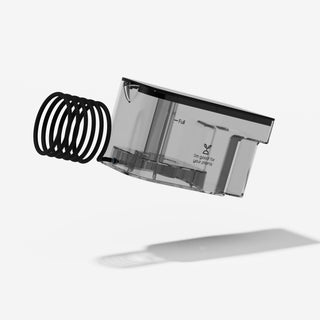
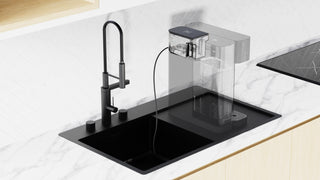
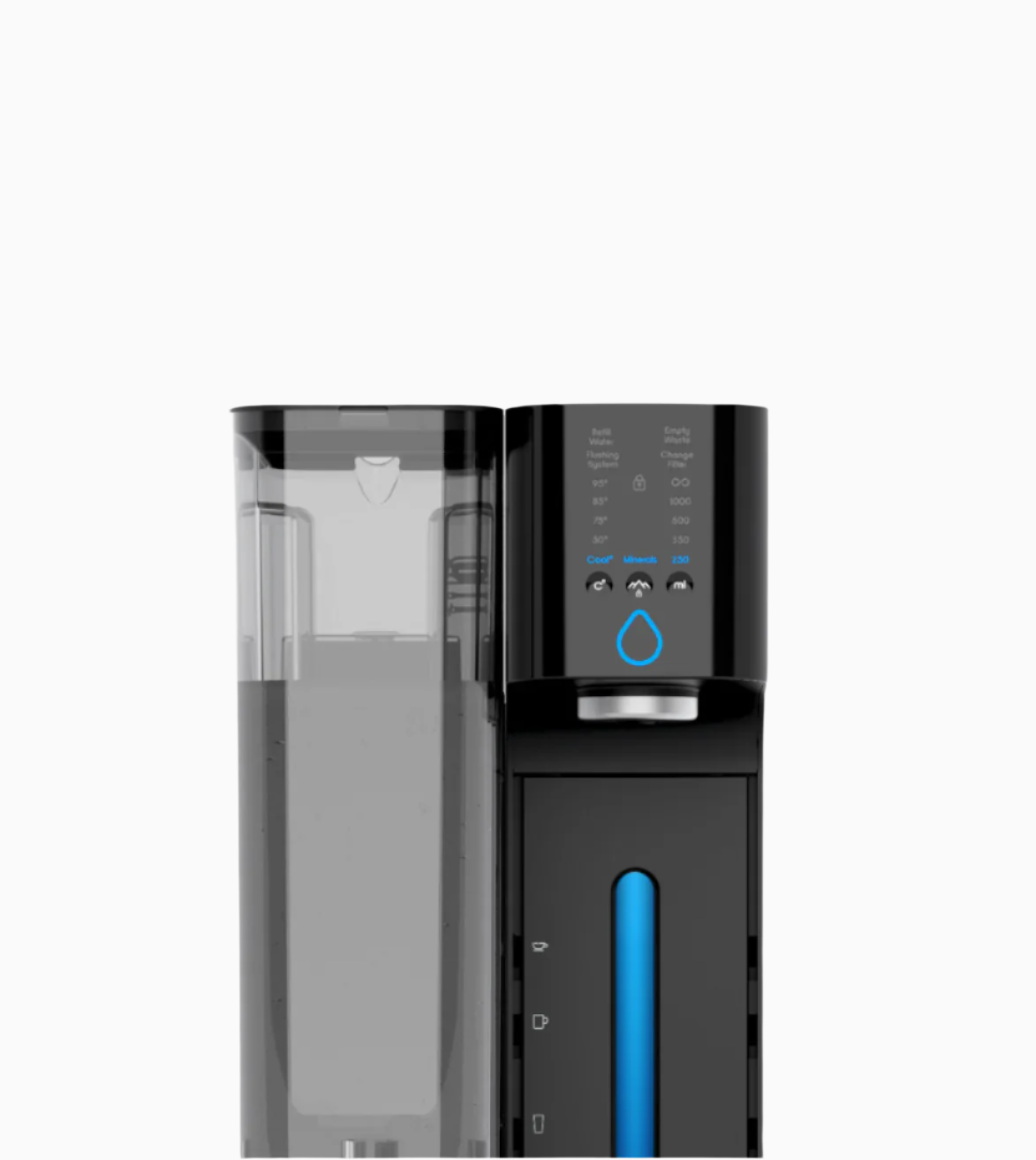
At Sküma Water, this is exactly the principle behind the MY™ Station: a first filtration stage combining sediment, activated carbon and reverse osmosis, followed by remineralisation according to different profiles.
Activated carbon notably plays a pre-filtration and adsorption role, while reverse osmosis forms the main barrier against a wide range of dissolved substances.
Reverse osmosis vs activated carbon: the full comparison table
Important: this table describes the general capabilities of each technology. Actual performance should always be checked for the specific model and configuration of the system in question.
|
Criterion |
Activated carbon |
Reverse osmosis |
|
Principle |
Adsorption |
Membrane separation under pressure |
|
Chlorine |
Very effective |
Can be reduced, but carbon is generally used upstream to protect the membrane |
|
Taste and odour |
Very effective on many molecules |
Can be improved, but depends on the system's design |
|
Organic compounds |
Variable effectiveness, often good |
Variable reduction depending on the substance |
|
PFAS |
Some PFAS, variable effectiveness |
Significant reduction of many PFAS |
|
Nitrates |
Little or no effect |
Significant reduction |
|
Sodium |
Little or no effect |
Significant reduction |
|
Dissolved salts |
Little or no effect |
Strong reduction |
|
Calcium |
Retained |
Strongly reduced |
|
Magnesium |
Retained |
Strongly reduced |
|
Dissolved metals |
Variable effectiveness |
Significant reduction for many metals |
|
Bacteria |
Not a reliable microbiological barrier on its own |
Significant physical barrier |
|
Viruses |
Not a reliable barrier |
Significant barrier |
|
TDS |
Little changed |
Strong reduction |
|
Energy |
Low energy requirement |
Requires pressure |
|
Reject water |
No intrinsic reject linked to adsorption |
Produces a concentrate/reject stream |
|
Maintenance |
Regular media replacement |
Filter and membrane replacement |
|
Final mineralisation |
Broadly retained |
Strongly reduced, which is why remineralisation can be worth considering |
Why the best systems actually combine activated carbon and reverse osmosis
Pitting activated carbon against reverse osmosis isn't always the right framing, then.
In a well-designed system, the two technologies can play different roles.
Activated carbon can notably be placed upstream of the reverse osmosis membrane.
Why?
Because certain elements present in water, notably the chlorine used to disinfect drinking water, can degrade certain reverse osmosis membranes.
A carbon pre-filter can therefore treat certain substances before the water reaches the membrane.
You then get a treatment chain in which each technology does what it does best.
Sediment → activated carbon → reverse osmosis → remineralisation
This is a far more interesting treatment logic than a simplistic opposition between two technologies.
Reverse osmosis: what are its drawbacks?
Presenting reverse osmosis as a technology that's superior on every criterion would be just as misleading as presenting activated carbon as a universal solution.
Reverse osmosis has real constraints.
1. It also removes minerals
This is the main point to bear in mind.
A high-performing reverse osmosis system produces significantly demineralised water. If the goal is to obtain water containing a certain amount of calcium, magnesium or other minerals, a remineralisation step may therefore be necessary.
2. It requires pressure
Water has to be pushed through the membrane.
This generally involves a pump or sufficient mains pressure, depending on the system's configuration.
3. It produces a concentrate
Not all the substances retained by the membrane simply disappear.
They're concentrated in the reject stream.
This is a fundamental difference from activated carbon: with a membrane, part of the water is separated from the treated flow and discharged with a higher concentration of retained substances.
The amount of water discharged varies considerably between systems.
It's therefore worth looking at the actual ratio between produced water and reject water, rather than generalising.
4. The membrane and filters need maintaining
A membrane doesn't last forever.
Like any filtration system, reverse osmosis needs to be maintained, and its consumables replaced according to the manufacturer's recommendations.
The EPA notes, moreover, that a domestic system's performance depends heavily on sticking to replacement and maintenance intervals.
And activated carbon: what are its limits?
Activated carbon has its own constraints too.
The main one is its selectivity.
It can be extremely effective against certain substances and far less effective against others.
A filter should therefore never be chosen simply because it contains “activated carbon”.
It's worth looking at:
• what type of carbon is used;
• how much media is present;
• what the contact time with the water is;
• which contaminants have been tested;
• what reductions were measured;
• over how many litres;
• and what certification or independent documentation backs up these performance figures.
Another essential point is saturation.
An activated carbon filter accumulates the substances it adsorbs. Its capacity isn't infinite, then.
A poorly maintained filter isn't equivalent to a new one.
That's true for activated carbon just as much as for reverse osmosis.
So, which technology should you choose?
The answer depends on your goal.
If your main concern is chlorine, taste or certain organic molecules, a good activated carbon filter can be perfectly suitable.
If you're looking to more broadly reduce dissolved substances, notably nitrates, salts, certain metals, certain PFAS and a significant share of dissolved solids, reverse osmosis offers a much wider barrier.
But that performance comes with a consequence: it also significantly reduces the minerals naturally present in the water.
That's why the more interesting question, ultimately, isn't:
“Activated carbon or reverse osmosis?”
It's rather:
“What do we want to remove from our water, and what composition do we want to end up with?”
It's this second question that helps explain why a treatment chain combining several technologies can be more relevant than a single filter.
Why Sküma uses reverse osmosis
At Sküma Water, our approach starts from a simple idea: purification and the water's final composition are two different subjects.
The MY™ Station uses a Super-Filter combining several stages: sediment filtration, coconut-shell activated carbon and reverse osmosis.
Activated carbon notably comes in upstream of the membrane, while reverse osmosis allows for a much broader reduction of dissolved substances.
But we don't treat purification as the final step.
Once the water has been thoroughly purified, it can be remineralised according to the chosen profile.
With the MY™ Station's different mineral profiles, the goal isn't simply to produce water that's had the maximum amount of things removed from it.
It's to give you more control over what's actually in the water you drink.
This is an important difference between an approach based purely on filtration and one based on personalising water after purification.
Reverse osmosis vs activated carbon: what to take away
Activated carbon and reverse osmosis aren't two versions of the same technology.
Activated carbon works mainly through adsorption. It's particularly good for chlorine, taste, odour and many organic compounds. It can also reduce certain PFAS, but its performance depends heavily on the contaminant and the filtration conditions.
Reverse osmosis relies on a semi-permeable membrane under pressure. It can reduce a much wider range of dissolved substances, notably salts, nitrates, certain metals and many PFAS.
But that capability comes with an unavoidable consequence: it also significantly reduces the minerals in the water.
This doesn't mean reverse osmosis is a bad technology.
It means the process needs to be understood as a whole.
Purifying, then choosing the water's final composition, rather than simply trying to remove the maximum number of substances, is a more complete approach.
And that's exactly where remineralisation takes on its full meaning.
FAQ: reverse osmosis and activated carbon
Does reverse osmosis remove minerals from water?
Yes. Reverse osmosis significantly reduces dissolved solids and can remove the vast majority of the calcium and magnesium present in the source water. This is a normal consequence of how the membrane works.
Does activated carbon remove minerals?
Generally, no. Activated carbon isn't designed to remove dissolved mineral salts such as calcium or magnesium.
Does activated carbon remove nitrates?
Standard activated carbon isn't an effective technology for reducing nitrates. Other technologies, notably reverse osmosis or certain ion-exchange processes, are far better suited to the task.
Does reverse osmosis remove nitrates?
Yes, reverse osmosis can significantly reduce nitrates. The exact performance depends on the system and its operating conditions.
Does reverse osmosis remove PFAS?
Reverse osmosis is an effective technology for reducing many PFAS. Activated carbon can also be effective against certain PFAS, particularly some long-chain PFAS. Performance should be verified for the specific contaminant and system involved.
Can you drink water that's been through reverse osmosis?
Yes. Water from a domestic reverse osmosis system can be intended for drinking. What matters is knowing its final composition and, when it's significantly demineralised, deciding whether remineralisation is wanted.
Why remineralise water after reverse osmosis?
Because reverse osmosis removes a large share of the minerals along with the other dissolved substances. Remineralisation allows certain minerals to be reintroduced, giving you more control over the water's final composition.
Is reverse osmosis water dangerous?
There's no conclusion suggesting that all demineralised water is automatically dangerous. The WHO does note, however, that water can contribute to calcium and magnesium intake, and has studied the potential consequences of prolonged consumption of very low-mineral water. The question should therefore be considered within the broader context of diet and the water's composition.
Is activated carbon enough to filter tap water?
It depends on what you want to remove. For chlorine, taste and certain organic molecules, it can be very effective. On its own, however, it isn't well suited to many dissolved salts, nitrates and certain other substances.
Is reverse osmosis better than activated carbon?
There's no universal answer. The two technologies aren't pursuing exactly the same goal. For a broad reduction of dissolved substances, reverse osmosis offers a much wider barrier. For chlorine, taste and certain organic molecules, activated carbon can be particularly relevant.
Why use activated carbon before reverse osmosis?
Activated carbon can reduce certain substances present in the water before it reaches the membrane, notably chlorine, helping to protect the membrane depending on its design.
Is water with a high TDS bad?
Not necessarily. TDS measures the total quantity of dissolved solids, but doesn't directly tell you their nature. You need to know the water's composition to interpret this figure correctly.