


Intermittent fasting has become one of the most talked-about subjects in health and longevity. Weight loss, energy, autophagy, inflammation, blood sugar regulation… The promises are substantial.
But behind all the noise, one question rarely gets asked: what actually happens to hydration when we fast?
Because a significant part of the negative effects attributed to fasting, fatigue, headaches, irritability, difficulty concentrating, doesn't come solely from the absence of calories. It can come from progressive dehydration, electrolyte loss, or a mineral imbalance that builds up unnoticed.
The real hidden story of intermittent fasting may not be about "not eating" at all. It may be about not understanding how the body manages water during that time.
Why we eat differently than we used to
For most of human history, periods without food were a natural part of biological life. The body evolved in a context of alternation, not constant abundance.
Our modern environment has broken that rhythm: continuous snacking, refined sugars, ultra-processed food, relentless insulin stimulation. In today's world, we spend an average of 15 to 16 hours a day in a post-prandial state, actively digesting. This constant demand keeps insulin levels persistently elevated and prevents the body from attending to its maintenance tasks.
"What we call 'intermittent fasting' today is simply returning to a rhythm that modern life has gradually erased. The human body was never designed to receive food around the clock. For millennia, periods without food intake were the norm, not the exception." — Julie Hanin, naturopath
Intermittent fasting is, in part, a response to this metabolic rupture. The principle is straightforward: alternating periods of eating and periods without caloric intake, giving the body the time it needs to draw on its reserves and regulate key biological processes. But framing it as mere "caloric restriction" misses the point entirely.
"The issue isn't insulin itself: it's its chronic, continuous secretion driven by our modern eating habits. A period without food allows insulin to drop. And it's precisely that window of low insulin that gives the body the space to rebalance." — Julie Hanin, naturopath
What science actually says about intermittent fasting
Current scientific literature shows that intermittent fasting can have meaningful effects on several biological markers: improved mitochondrial function, enhanced fatty acid oxidation, better glycaemic regulation, reduced oxidative stress and inflammatory responses, and the induction of autophagy.
Studies suggest that longer breaks between meals are associated with a reduced risk of cardiovascular events and certain cancers. Autophagy, the cellular self-cleaning process triggered by fasting, is also being actively studied as a potential pathway in neurodegenerative diseases such as Alzheimer's and Parkinson's.
"In the first few hours, the body draws on its hepatic glycogen stores. Around the 14 to 16-hour mark, it shifts into a different mode: it begins mobilising stored fat and producing ketone bodies. Ketones are a remarkably efficient alternative fuel for the brain, which is often why people report improved mental clarity after a few days of adaptation." — Julie Hanin, naturopath
That said, the science is more nuanced than the version circulating on social media. Intermittent fasting is not a universal solution. Its effects vary considerably depending on metabolic profile, stress levels, sleep quality, physical activity, sex and overall diet. Experts also flag that fasting, when poorly managed, can increase the risk of dehydration, electrolyte imbalances, dizziness and muscle loss.
The real question isn't whether fasting is "good" or "bad", it's whether the physiological conditions for it to work are actually in place.
The underestimated role of hydration during fasting
This is probably the most overlooked angle in the conversation.
What happens in the body from the very first hours
When we stop eating, the body first turns to its glycogen stores in the liver and muscles for energy. Each gram of glycogen is bound to approximately three to four grams of water. As these reserves are metabolised, that bound water is released into the bloodstream and excreted by the kidneys, triggering a powerful diuretic effect and rapid fluid loss.
"We fixate on 'when to eat' and forget that food also delivers water. A meaningful portion of our daily hydration comes from what we eat, fruit, vegetables. We remove the meals without accounting for what that means in terms of fluid intake." — Julie Hanin, naturopath
There's more. Once glycogen stores are depleted, typically within 24 to 48 hours, the kidneys shift gear. Rather than retaining water and minerals, they begin excreting them at an accelerated rate. This is known as natriuresis. The direct consequence: the difficulty of the first few days of fasting often isn't hunger, it's a mineral deficit. Headaches, dizziness, muscle cramps and fatigue are the body's signals of a drop in electrolytes.
Drinking more isn't enough
Without adequate electrolytes, sodium in particular, water can move through the body without being properly absorbed at the cellular level, creating persistent feelings of dehydration despite increased fluid intake.
"Low sodium can trigger headaches, dizziness, and sudden fatigue. Low magnesium can bring on cramps, irritability, disrupted sleep. These aren't effects of fasting itself, they're the effects of poorly managed hydration during a fast." — Julie Hanin, naturopath
Sodium, potassium and magnesium play a foundational role in fluid balance, nerve transmission, muscle function and recovery. In other words: the quality and mineral composition of the water you drink during a fast directly determines how effectively your cells are hydrated.
"When clients come to me complaining of fatigue or headaches during a fast, the first thing I ask isn't 'have you eaten?' It's 'what have you been drinking, and with what?' Dismissing fasting as 'not working for me' should come after ruling out a hydration issue, not before." — Julie Hanin, naturopath
Fasting as a deeply personal protocol
One of the most persistent misconceptions about intermittent fasting is the idea that a single model works for everyone. In reality, fasting functions as a controlled physiological stressor and like any stressor, how well it's tolerated depends entirely on individual terrain.
A high-performance athlete, a woman navigating a sensitive hormonal window, someone dealing with chronic stress or accumulated sleep debt, none of these people will respond the same way.
"People with an already-taxed adrenal system often don't do well with extended morning fasts: the morning is naturally the cortisol peak, and pushing the fast through it can amplify the stress response rather than calm it. For these profiles, shifting the eating window earlier in the day and allowing a longer overnight fast tends to work much better. Fasting isn't a single formula. It's a tool. And like any tool, its effectiveness depends on how it's used, and for whom." — Julie Hanin, naturopath
This is why modern functional health approaches no longer treat fasting purely as a dietary method, but as a comprehensive protocol that integrates circadian rhythm, sleep, recovery, physical activity and hydration. Within this framework, water becomes far more than a fasting companion. It becomes an active physiological variable.
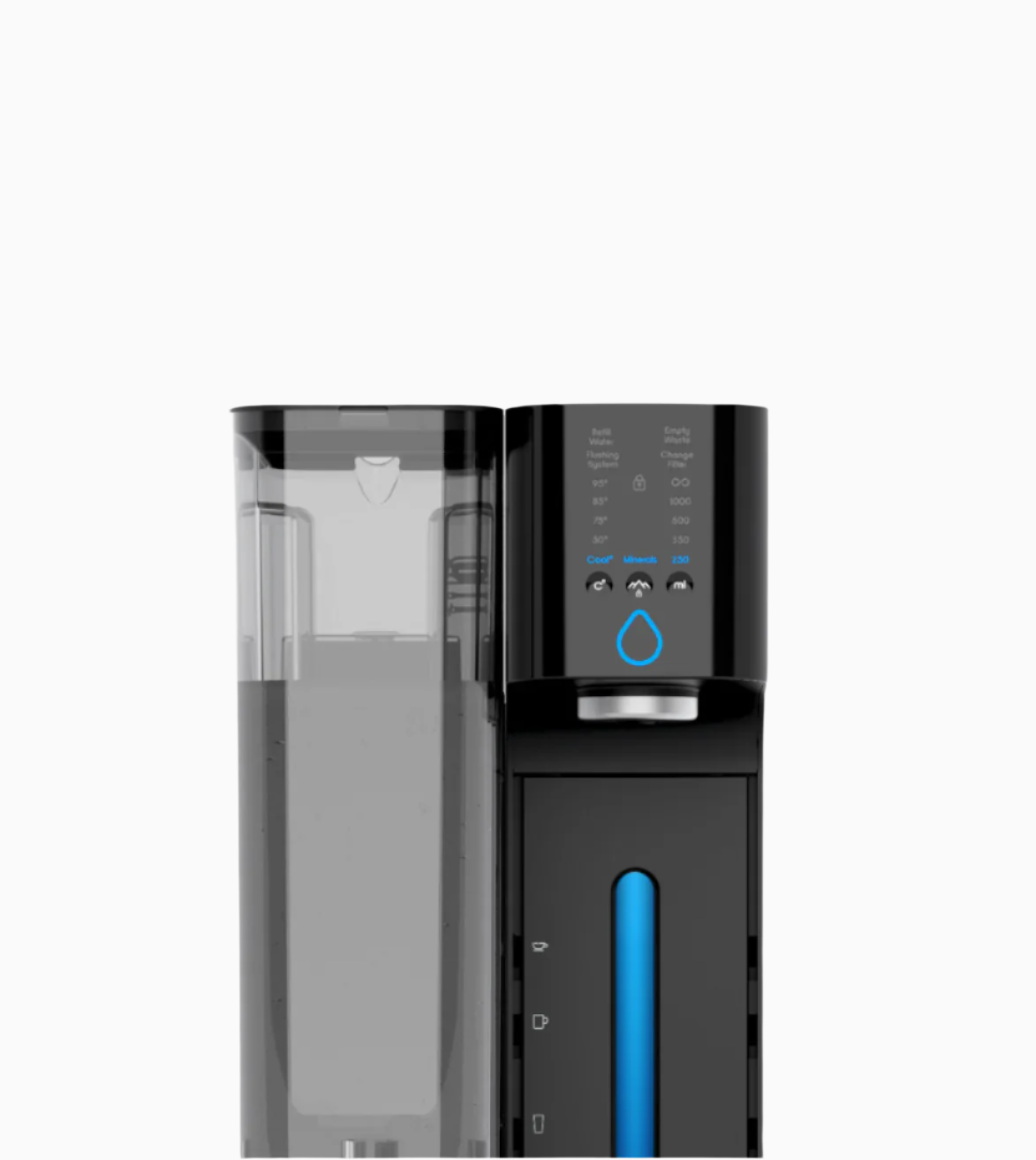
This is precisely what the Sküma Water approach is built around: optimising hydration isn't just about filtering water. It's about controlling its quality, purity and mineral balance to match what the body actually needs; especially in contexts where it's being asked to do something demanding, like fasting.
In closing
Intermittent fasting is probably neither a passing trend nor a miracle solution. The real shift is deeper than that.
We're entering an era where biological rhythm, energy, inflammation, hydration and the invisible habits of daily life are becoming central health subjects. In this framework, water is no longer simply something you drink alongside a fast. It's an active variable in the whole equation.
The path to better health doesn't only run through what we eat. It runs through what we drink, every single day.
Sources
-
Margină D.M., Drăgoi C.M. – Intermittent Fasting on Human Health and Disease. Nutrients, 2023. pmc.ncbi.nlm.nih.gov
-
Institut Pasteur – Intermittent fasting and cellular autophagy. 2024. pasteur.fr
-
Biology Insights – How Much Water Should I Drink When Fasting? 2026. biologyinsights.com
-
BodySpec – Water Fasting Electrolytes: Dosage, Recipes & Safety. StatPearls ref., 2023. bodyspec.com
-
BUBS Naturals – Do You Need Electrolytes When Water Fasting? 2026. bubsnaturals.com
-
Heyman S.N. et al. – Fasting-Induced Natriuresis and SGLT: A New Hypothesis. Frontiers in Endocrinology, 2020. frontiersin.org
-
PMC – Reduced dietary intake induces body fluid hypotonicity via alterations in water and energy metabolism. 2025. pmc.ncbi.nlm.nih.gov
-
ScienceDaily – Seven days of fasting transforms the human body. 2024. sciencedaily.com
Co-written with Julie Hanin, naturopath. Verbatim quotes represent professional opinions and do not constitute medical claims.