


The short answer: hard water is tap water carrying a lot of dissolved calcium and magnesium, picked up as rain soaks through chalk and limestone. It is safe to drink, but above approximately 200 mg/l it leaves limescale wherever water is heated, wears out appliances, takes more soap to clean with and puts a film on your tea.
How hard your water is depends on where you live. London's City supply zone averaged 266 mg/l in 2025, most of Scotland is soft, and much of Paris, Strasbourg and Brussels sits at the hard end of the scale.
Here is what hard water is, how it affects you day to day, what the research says, and how to deal with it, from a descaled kettle to filtered water.
What is hard water?
Hard water is water that contains a high level of dissolved calcium and magnesium. Rain is naturally soft, but as it seeps through chalk and limestone on its way to a borehole or river, it dissolves these two minerals. According to the Drinking Water Inspectorate (DWI), which regulates tap water in England and Wales, how hard your water is depends on the local geology.

Hardness has two parts:
1. Temporary (or carbonate) hardness: this comes from calcium carbonate and forms scale when water is heated.
2. Permanent hardness: this comes from calcium and magnesium sulphate and does not form scale when heated.
Source: United Utilities 2024 hardness factsheet.
In short: hardness is calcium and magnesium from the ground, and the carbonate part is what turns into limescale.
How is water hardness measured?
Water hardness is measured in milligrams of calcium carbonate per litre (mg/l). In France and Belgium it is usually given in French degrees (°f), where one French degree equals 10 mg/l, and in Germany in German degrees (°dH). The DWI classes water as hard from 200 mg/l and very hard above 300 mg/l.
| Hardness | mg/l as calcium carbonate | French degrees (°f) |
|---|---|---|
| Soft | up to 100 | up to 10 |
| Slightly hard | 100 to 150 | 10 to 15 |
| Moderately hard | 150 to 200 | 15 to 20 |
| Hard | 200 to 300 | 20 to 30 |
| Very hard | over 300 | over 30 |
In short: the same water can read 266 mg/l in London or 26.6 °f in Paris; it is one scale in two units.
How hard is the water in the UK, France and Belgium?
Hardness follows the rocks, so it changes from region to region and sometimes from street to street. Areas on chalk and limestone, including London, parts of Surrey, Paris, Strasbourg and Brussels, have hard water. Most of Scotland has soft water, because chalk and limestone are rare there, according to Scotland's drinking water regulator.
| Place | Hardness | Band |
|---|---|---|
| London, City supply zone (2025 average) | 266 mg/l (26.6 °f) | Hard |
| Paris, by distribution zone (2024) | 14 to 36.5 °f | Slightly hard to very hard |
| Strasbourg (average) | 26 °f | Hard |
| Brussels | 21 to 42 °f | Hard to very hard |
| Most of Scotland | Mostly under 100 mg/l (under 10 °f) | Soft |
The figures come from Thames Water's 2025 water quality report, Eau de Paris's 2024 annual report, the Eurométropole de Strasbourg, Brussels' supplier Vivaqua, as reported by The Brussels Times in 2025, and Scotland's drinking water regulator, which classes most Scottish supplies as soft.
In short: if you live on chalk or limestone, from London to Paris to Brussels, your water is probably hard.
How can I find out how hard my water is?
The quickest way to find out how hard your water is, is to ask your water supplier. Most UK suppliers have a postcode checker on their website, and in France and Belgium suppliers and communes publish hardness with their annual water quality results.
In short: your supplier already measures it, so start there.
Is hard water safe to drink?
Yes, hard water is safe to drink. Neither EU rules nor UK regulations set any limit for hardness, calcium or magnesium in drinking water, the DWI notes. Health Canada's 2024 review of drinking water parameters reaches the same conclusion: calcium and magnesium are not a public health concern at the levels found in tap water.
Water suppliers on both sides of the Channel say the same. SES Water calls hard water "completely safe to drink", Scotland's regulator says tap water is safe whether hard or soft, and both Paris and Strasbourg say their hard water poses no risk to health. French rules even ask for water that is balanced or slightly scale-forming, because very soft water can corrode pipes.
Verdict: hard water is a question of taste and household wear, not safety.
What does hard water do in your home?
Hard water leaves limescale wherever water is heated, which shortens the life of appliances and makes them less efficient, according to the DWI. It also takes more soap and detergent to make a lather, leaves white marks on taps, sinks and shower glass, and at high levels changes how water tastes.
Scale forms because calcium carbonate comes out of hard water as it heats. United Utilities puts the point where scale becomes likely at around 200 mg/l, and Eau de Paris at around 20 °f, which is the same figure. The town hall of Paris's 11th arrondissement notes that calcium turns to scale mainly from 60 °C. That is why kettles, irons, coffee machines, dishwashers, shower heads and hot water cylinders take the brunt of it.
Taste is the other effect. New Zealand's water regulator, Taumata Arowai, puts the taste threshold for calcium between 100 and 300 mg/l, depending on the minerals it comes with, and United Utilities notes that people moving between areas often notice the difference, especially in tea.
In short: hard water costs you in descaling, cleaning products and appliance life, and at high levels it changes the taste.
What does the research say about hard water and tea?
The film on your tea is mostly the water. In 2021, researchers at ETH Zurich showed in Physics of Fluids that calcium carbonate in the water is the main driver of the thin, shiny film that forms on black tea, and that the film gets stronger the more calcium carbonate there is.
In a 2023 follow-up in Soft Matter, using artificial tap water at different hardness levels, the same team found that hardness is the biggest influence on how strong the film becomes. A squeeze of lemon weakened it so much that no visible film formed, even in hard water. The less obvious finding runs the other way: "the tea would taste quite bitter" if brewed in perfectly pure water, said lead author Caroline Giacomin of ETH Zurich.
Verdict: hard water makes the film on your tea, but some minerals make it taste better, so the aim is balance, not zero.
How do you reduce limescale at home?
You reduce limescale by removing the scale that has already formed and limiting how much new scale can form. Regular descaling deals with what is there. Lowering the hardness of the water you heat, or filtering the water you drink, deals with what comes next. These steps draw on advice from SES Water, the DWI and Eau de Paris.
| Step | What to do | Why it helps |
|---|---|---|
| 1. Check your hardness | Look up your supplier's figure for your postcode or commune | Tells you whether scale is likely (from about 200 mg/l, or 20 °f) |
| 2. Descale regularly | Soak the kettle, shower head and taps in white vinegar, then rinse | Vinegar dissolves calcium carbonate scale |
| 3. Mind the hot water temperature | Keep a hot water cylinder at 60 °C, not higher | Less scale forms in pipework, and 60 °C still keeps bacteria in check, SES Water advises |
| 4. Set your dishwasher | Set the salt or hardness level to match your supply | Matches the dishwasher to the water it gets |
| 5. Filter your drinking water | Use a filter that lowers hardness, such as an ion-exchange cartridge or reverse osmosis | Less hardness in means less scale out |
In short: descale what you have, then cut the hardness of the water you heat and drink.
Water softener, jug filter or reverse osmosis: which is best for hard water?
It depends on what you want to protect. A whole-house water softener protects pipes and appliances, but UK suppliers advise against drinking softened water. A jug filter with an ion-exchange cartridge reduces part of the hardness in the water you drink. Reverse osmosis removes almost all of it, which is why some systems add minerals back, such as Sküma® Water.
| Option | What it does to hardness | Drinking water | Upkeep |
|---|---|---|---|
| Descaling only | Removes existing scale; hardness unchanged | Unchanged tap water | Regular descaling |
| Whole-house softener | Swaps calcium and magnesium for sodium | Not advised: keep the kitchen tap unsoftened (DWI) | Professional installation and maintenance (DWI) |
| Jug filter, ion-exchange cartridge | Removes part of the calcium, reducing carbonate hardness (manufacturer data) | Yes | Cartridge changes, about every four weeks |
| Reverse osmosis with remineralisation | Removes almost all hardness, then adds a measured mineral profile back | Yes | Filter changes and occasional descaling |
The DWI's concern with softened water is sodium: a softener can raise it beyond what some people should have, and SES Water says softened water should not be used for baby bottles. EU rules recognise a related point, allowing countries to set a minimum calcium, magnesium or mineral level for softened or demineralised water. France had not yet set one in its health ministry's 2023 guidance.
Verdict: soften for your pipes if you like, but filter the water you drink, and keep some minerals in it.
How does Sküma® help with hard water?
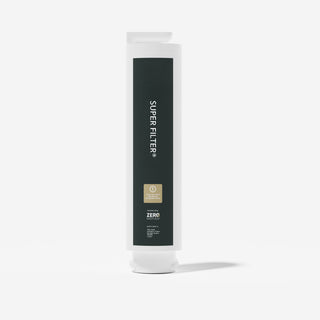
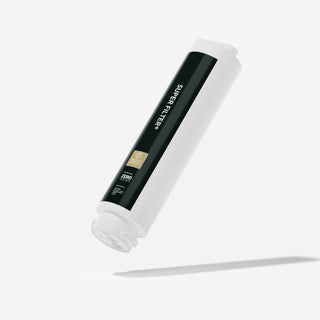
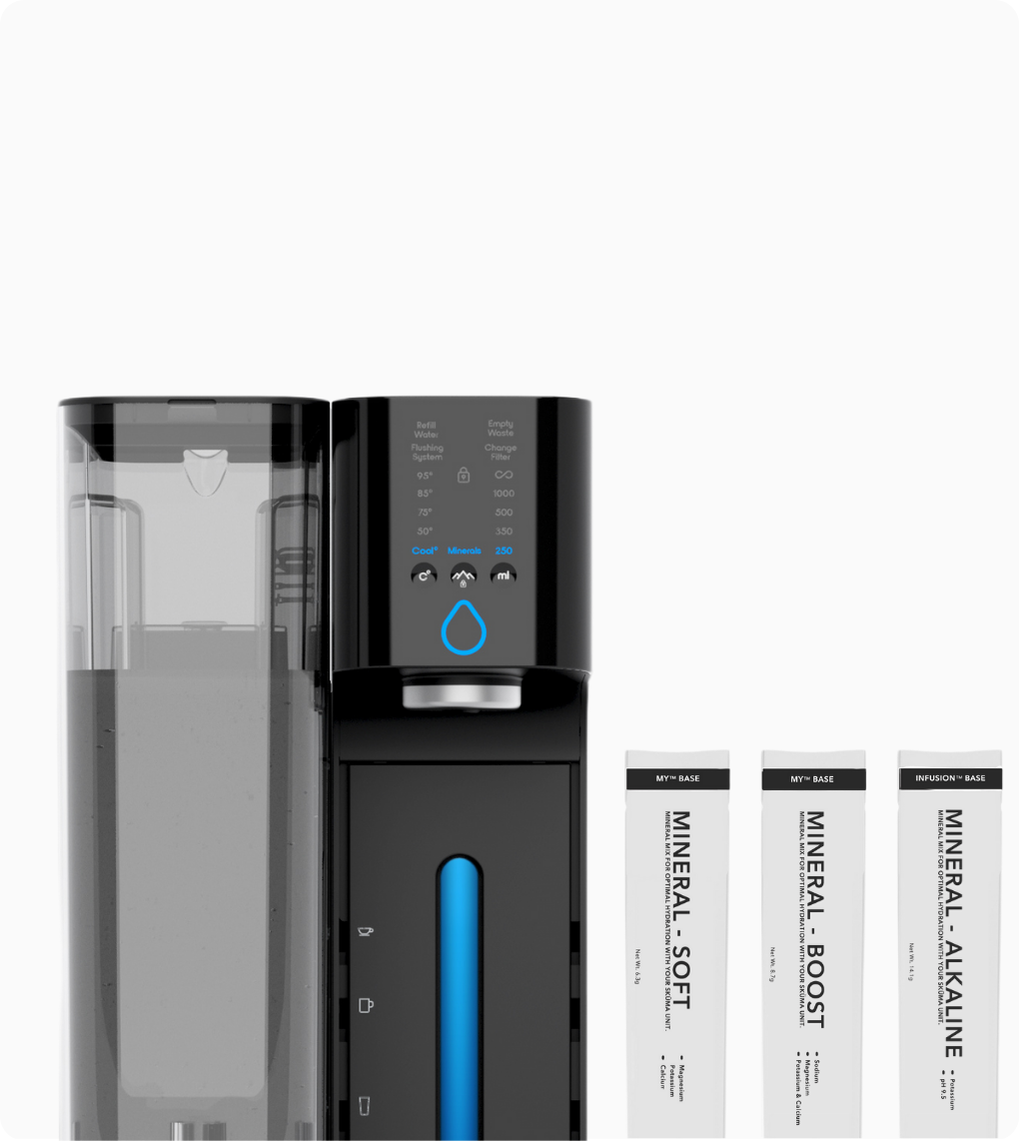
The Sküma® MY™ Station takes the hardness out of your tap water and then puts back only the minerals you choose. Its three-stage Super-Filter, ending in a reverse osmosis membrane, brought total hardness down from 315 to 14 mg/l in an independent test by a COFRAC-accredited French laboratory in February 2025. MY™ Bases then add a measured mineral profile, Soft, Plus or Alkaline, to cold and hot water alike. Worked out from the minerals each profile declares, they add between about 20 and 120 mg/l of hardness, so even with what the filter lets through, the water stays well under the 200 mg/l where scale becomes likely. Hot water comes on demand at 50, 75, 85 or 92 °C, and many of our customers tell us they no longer use a kettle at all. It sits on the counter with no plumbing, so it works in a rented flat in Paris or Brussels as well as a family kitchen in London.
Verdict: purify first, then add back the minerals you want, in the amount you want.

What to remember
Hard water is calcium and magnesium from chalk and limestone, and it is safe to drink. Above about 200 mg/l (20 °f) it scales anything that heats water, takes more soap and can be tasted, from London to Paris to Brussels. Descale regularly, keep softened water away from the kitchen tap, and filter the water you drink while keeping some minerals in it.
Questions about hard water
What is the difference between hard and soft water?
Hard water carries a lot of dissolved calcium and magnesium; soft water carries little. The DWI classes water as soft up to 100 mg/l of calcium carbonate and hard from 200 mg/l. Hard water forms limescale when heated and needs more soap, while very soft water can be more corrosive to pipes.
Is hard water bad for you?
Not necessarily. Neither EU nor UK rules set a limit for hardness, calcium or magnesium in drinking water, and Health Canada's 2024 review finds calcium and magnesium of no public health concern at tap water levels. Hard water's effects are on taste, cleaning and appliances, not on safety.
Does boiling water remove hardness?
Partly. Boiling turns temporary, or carbonate, hardness into calcium carbonate scale, which is why it collects in the kettle. Permanent hardness, from calcium and magnesium sulphate, stays dissolved and does not form scale, according to United Utilities. Boiling moves hardness from the water onto the element rather than getting rid of it.
Does a jug filter remove hard water?
A jug filter with an ion-exchange cartridge removes part of the calcium, which reduces carbonate hardness and the scale it forms, according to filter maker Brita. It does not remove all hardness. Reverse osmosis removes almost all of it: in Sküma's 2025 laboratory test, total hardness fell from 315 to 14 mg/l.
How do I remove limescale?
Soak the scaled part in white vinegar, then rinse it thoroughly with clean water. Vinegar dissolves calcium carbonate scale on kettles, shower heads, taps and water tanks. In a hard water area, descale regularly rather than waiting for a thick layer, and check your appliance's own instructions first.
Why is there a film on my tea?
Calcium carbonate in hard water reacts with compounds in the tea to form a thin, shiny film, ETH Zurich researchers found in 2021 and 2023. The harder the water, the stronger the film. A squeeze of lemon breaks it up, and tea brewed in perfectly pure water forms no film but tastes bitter.
Should I drink softened water?
UK water suppliers advise against it. Softeners swap calcium and magnesium for sodium, so the DWI recommends keeping the kitchen tap unsoftened for drinking and cooking, and SES Water says softened water should not be used for baby bottles. Softeners are for protecting pipes and appliances.
Does the Sküma® MY™ Station remove hardness?
Yes. Its reverse osmosis Super-Filter brought total hardness from 315 to 14 mg/l in a 2025 test by a COFRAC-accredited French laboratory. MY™ Bases then add back a measured mineral profile of your choice, which adds about 20 to 120 mg/l of hardness, below the level where scale becomes likely.
Does a MY™ Station need descaling in a hard water area?
Yes. Some scale still builds up over time, so we recommend descaling the MY™ Station every 12 to 16 weeks, or after eight weeks without use. The Super-Filter lasts 750 to 1,100 litres, and the harder your tap water, the sooner it needs changing.
Sources: Drinking Water Inspectorate, water hardness guidance (2026); Thames Water, water quality report, City supply zone (2025); SES Water, water hardness and limescale (2026); United Utilities, water hardness factsheet (2024); Drinking Water Quality Regulator for Scotland, water hardness; Scottish Water, water hardness factsheet (2020); Health Canada, operational parameters consultation (2024); Taumata Arowai, aesthetic values for drinking water (2022); Eau de Paris, annual water quality report (2024); Mairie du 11e arrondissement de Paris, L'eau à Paris (2026); Eurométropole de Strasbourg, water quality (2025); Vivaqua, via The Brussels Times (2025); French Ministry of Health, note DGS/EA4/2023/61 (2023); Brita, how water filters work (2026); Giacomin and Fischer, Physics of Fluids (2021); Giacomin, Chen, Hack and Fischer, Soft Matter (2023); Sküma® laboratory test, COFRAC-accredited laboratory (2025); Sküma® FAQ (2026). Last updated: 22/10/2026.
Note: this article is for information purposes and does not replace medical advice.