


The short answer: bottled water is mostly water and minerals, plus a surprising amount of plastic. A 2024 Columbia University study counted about 240,000 plastic particles in a typical litre, around 90% of them nanoplastics. The World Health Organization finds no proven harm yet, but calls the data very limited and advises reducing exposure.
It also asks a lot of you. Two adults drinking two litres a day get through about 730 two-litre bottles a year: roughly 14 a week to buy, carry home and recycle, at £584 to £730 a year.
Here is what researchers have found in the bottle, what it means for your health, and how it compares with the alternatives.
What are microplastics and nanoplastics?
Microplastics are plastic particles between one thousandth of a millimetre (1 µm) and 5 mm across. Nanoplastics are smaller than 1 µm, too small to see with an ordinary microscope. That is the size split the 2024 Columbia study uses, and it matters, because the smaller a particle is, the harder it is to count and the further it may travel in the body.
In bottled water, the plastics researchers find are everyday ones: polypropylene, used for bottle caps; PET, used for most drinks bottles; and polyamide (nylon), polystyrene and PVC.
In short: microplastics are tiny, nanoplastics are tinier, and both come from everyday plastic.
How much plastic is in bottled water?
More than most people expect. In 2018 chemist Sherri Mason and colleagues at the State University of New York at Fredonia tested 259 bottles from 11 brands bought in nine countries. They found microplastic contamination in 93% of them, at an average of about 325 particles per litre.

That method stained particles with a fluorescent dye and could only see down to about 6.5 µm. In 2024, a team led by Columbia University chemist Wei Min used stimulated Raman scattering, a laser imaging technique that identifies plastics by their chemical signature, to look at three bottled water brands. They counted about 240,000 plastic particles per litre, and around 90% were nanoplastics that earlier studies could not detect.
In short: the closer researchers look, the more plastic they find.
Where does the plastic in bottled water come from?
Partly from the bottle itself. In the 2018 study, polypropylene made up 54% of the larger particles identified, and the authors linked it to the plastic used for bottle caps. In the 2024 study, polyamide was the most common plastic by number across all three brands, and in one brand PET made up the most plastic by weight.
In short: some of the plastic in bottled water comes from the packaging.
Is plastic in water harmful? What the evidence says
Nobody knows yet. In 2022 the World Health Organization reviewed the evidence on micro- and nanoplastics in food and drinking water and found that the limited data give little evidence of harm to people. It also said the data are of very limited use for judging the risk at all.
WHO still recommends reducing exposure where possible, by cutting plastic use and stopping plastic from being released into what we eat and drink. The authors of the 2024 study note that nanoplastics, small enough to cross the body's biological barriers, are where most of the open questions now lie.
Verdict: no proven harm, but the evidence is thin, and WHO advises reducing exposure.
Is bottled water purer than tap water?
Not necessarily. In England, tap water met the legal standards in 99.97% of tests in 2024, according to the Drinking Water Inspectorate. And in the 2018 comparison, bottled water carried roughly twice as many of the larger plastic particles as tap water: 10.4 against 5.45 per litre.
Bottled water also comes in different kinds. According to ANSES, France's food safety agency, natural mineral water must come from a protected underground source with a stable mineral content, and must not be disinfected. Spring water also comes from underground, and must meet the same chemical standards as tap water.
That rule is why one recent case matters. In 2024 Nestlé Waters acknowledged treating some of its natural mineral waters in France, including Perrier, Contrex, Vittel and Hépar, with methods not allowed for natural mineral water, and paid a €2 million fine to avoid prosecution. A French Senate inquiry reported in May 2025 that the government had known since at least 2022. The inquiry's president said there was no proven harm to anyone who drank the water, but buyers were paying a premium for a purity the label promised.
Verdict: bottled water is not automatically purer than what comes out of your tap.
How do bottled water, tap water, jug filters and reverse osmosis compare?
Each option makes a different trade between convenience, cost and how much it removes. Bottled water costs the most and carries the most plastic in the studies so far. A jug filter is cheap but needs constant upkeep. Reverse osmosis removes the most, then needs minerals adding back.
| Bottled water | Tap water | Jug filter (Brita MAXTRA PRO) | Reverse osmosis (Sküma® MY™ Station) | |
|---|---|---|---|---|
| Where it comes from | A spring or mineral source, bottled | Your water supplier | Your tap | Your tap |
| Packaging | A new plastic bottle each time | None | Reusable jug and cartridges | Reusable unit and filter |
| What is treated or removed | Natural mineral water may not be disinfected | Treated to legal standards, 99.97% compliance in England (2024) | Chlorine, lead, copper, some pesticides, PFAS (Brita's own testing) | 99.9% of 229 contaminants, microplastics 316 to 6 particles (2025 lab test) |
| Minerals | Whatever the source carries | Whatever your area's water carries | Some hardness removed | Removed, then added back by MY™ Bases |
| Upkeep for two adults | About 14 two-litre bottles a week | None | A new cartridge every 4 weeks, 1.4 litres per fill | Super-Filter rated 750 to 1,100 litres, one MY™ Bases pouch per 40 litres |
| Cost for two adults, year one | £584 to £730 | On your water bill | About £80 | From £379 to start |
Prices checked on 14/10/2026 at Tesco and Morrisons. Jug filter details are from Brita.
In short: filtering at home takes the bottle out of the picture.
What does a bottled water habit really cost?
Two adults drinking two litres a day each need about 1,460 litres a year. That is about 730 two-litre bottles, or 14 a week.
At 40p a litre for a supermarket own-label still water, that comes to about £584 a year. At 50p a litre for a branded spring water such as Highland Spring, it is about £730. Over two years, that is £1,168 to £1,460, before counting the trips to the shop and the recycling bin.
In short: about 14 bottles a week, and up to £730 a year.
Where does the Sküma® MY™ Station fit in?
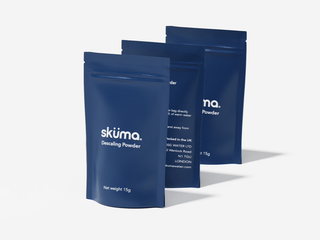
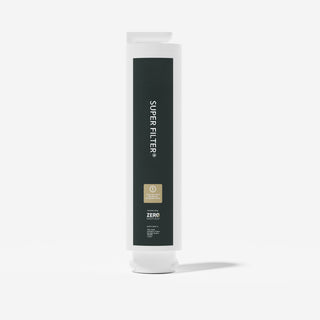
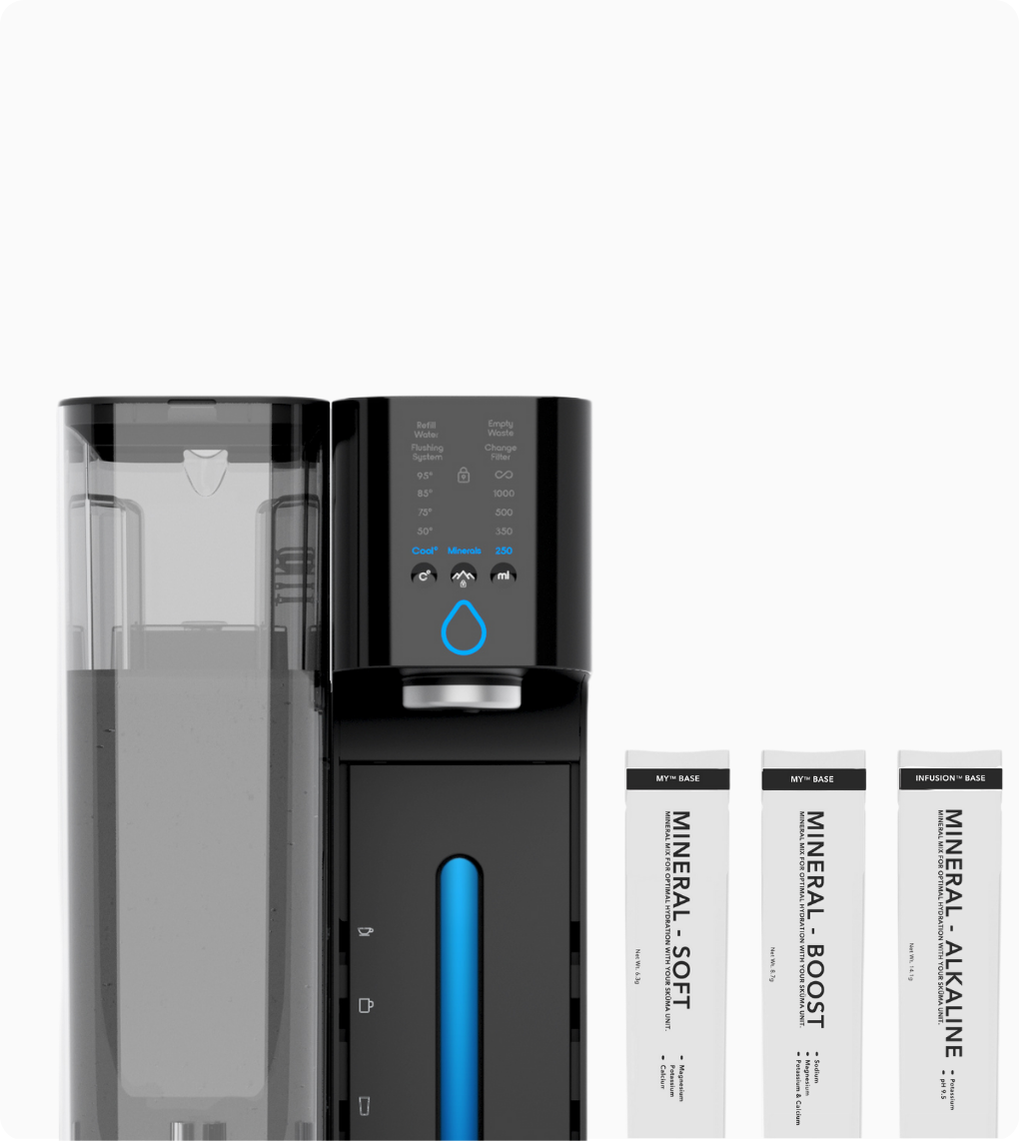
The MY™ Station sits on your counter and needs no plumbing. It runs tap water through one Super-Filter with three stages, a carbon block, a sediment filter and a reverse osmosis membrane, then adds back the minerals you choose with MY™ Bases.

In February 2025 an independent COFRAC-accredited French laboratory tested the Super-Filter against 229 contaminants found in tap water, including 20 PFAS, 165 pesticides and 14 heavy metals. It removed 99.9% of them, and microplastics fell from 316 particles to 6, a 98% reduction. MY™ Bases can arrive by subscription, so there are no bottles to carry home.
Already have a MY™ Station? The full laboratory results for your Super-Filter are on our Science page.
In short: purified water from your own tap, with no bottles to buy. Explore the MY™ Station.
What to remember
Researchers find plastic in most bottled water they test, and the newest methods count around 240,000 particles in a litre, mostly nanoplastics. WHO finds no proven harm but very limited data, and advises reducing exposure. Bottled water is not automatically purer than tap, and for two adults it means about 14 bottles a week and up to £730 a year. Filtering at home takes the bottle out of the picture.
FAQ: bottled water and plastic
Does bottled water contain microplastics?
Most of it does, in the studies so far. A 2018 study found microplastics in 93% of 259 bottles from 11 brands, at about 325 particles per litre.
What is the difference between microplastics and nanoplastics?
Size. Microplastics are 1 µm to 5 mm across, and nanoplastics are smaller than 1 µm. A 2024 study found that about 90% of the roughly 240,000 plastic particles per litre it counted in bottled water were nanoplastics.
Are microplastics in water bad for you?
There is no proven harm yet. WHO says the limited data give little evidence of adverse effects, but that the data are too limited to judge the risk properly, and advises reducing exposure.
Is tap water safer than bottled water?
Bottled water is not automatically purer. English tap water met the legal standards in 99.97% of tests in 2024, and one study found bottled water carried about twice as many larger plastic particles as tap water.
Is natural mineral water treated?
It must not be disinfected. Natural mineral water must come from a protected underground source with a stable mineral content, and only limited filtration is allowed, for example to remove iron.
How much does bottled water cost a year?
For two adults drinking two litres a day each, about £584 a year at 40p a litre and about £730 at 50p a litre.
Does the Sküma® MY™ Station remove microplastics?
In an independent laboratory test in February 2025, the Super-Filter reduced microplastics from 316 particles to 6, a 98% reduction.
Sources: Qian et al., Proceedings of the National Academy of Sciences (2024); Mason et al., Frontiers in Chemistry (2018); World Health Organization, Dietary and inhalation exposure to nano- and microplastic particles (2022); Drinking Water Inspectorate, Drinking Water 2024 (2025); ANSES, Bottled water: characteristics, safety and treatment (2026); Euronews, report on the French Senate inquiry into natural mineral water (2025); Brita, product information (2026); Tesco and Morrisons, prices on 14/10/2026; Sküma® laboratory test, February 2025. Photos: Jonathan Chng and charlesdeluvio, Unsplash; Sküma®.
Note: this article is for information purposes and does not replace medical advice.