


This article was written in partnership with Caroline Rinaudo, founder of FitMum France and a fitness coach who has specialised in supporting women during pregnancy, the postnatal period and motherhood for over 10 years.
Between feeds, disrupted nights, appointments, looking after the baby and the exhaustion of those first few weeks, there's one very simple thing that's easy to forget in the postnatal period: drinking water.
However, whilst breastfeeding, your body continues to work incredibly hard. Producing milk requires more water, which naturally increases your fluid needs.
So, how much water should you drink whilst breastfeeding? Should you force yourself to drink more to produce more milk? What sort of water should you choose whilst breastfeeding? And how should you adjust your fluid intake as you gradually return to exercise?
Water and breastfeeding: why do fluid requirements increase?
Breast milk is mainly made up of water: the World Health Organisation states that it contains over 80 per cent water.
Producing milk therefore logically leads to increased fluid requirements for the mother.
According to the nutritional reference values established by the EFSA, a breastfeeding woman needs around 700 mL more water per day than a woman of the same age who is not breastfeeding. The adequate total intake is therefore estimated at around 2.7 litres of water per day, including water from food.
Please note, however, that this does not mean you need to drink 2.7 litres of water every day.
Some of our water intake comes naturally from our diet: fruit, vegetables, soups, dairy products and vegetable-rich dishes also contribute to our fluid intake.
Above all, individual needs vary.
They can vary depending on:
- the outside temperature;
- your diet;
- your level of physical activity;
- how much you sweat;
- how often you're breastfeeding;
- your state of health.
The idea isn't to turn your water bottle into a new meter to keep an eye on all day long, but to drink regularly and be mindful of your body's needs.
Caroline's tip: in the postpartum period, your attention is often entirely focused on your baby. Your hydration can therefore easily take a back seat to everything else.
Establish a few simple routines: a glass of water when you wake up, a water bottle near your breastfeeding area, water with every meal, and a bottle when you leave the house.
"In the postpartum period, mums already have a thousand things on their minds. Staying hydrated shouldn't become an extra mental burden. A few simple habits, repeated every day, are often much easier to stick to than striving for perfection." — Caroline Rinaudo, founder of FitMum France
How much water should you drink whilst breastfeeding?
There is no single amount that applies to all breastfeeding women.
As we have just seen, the EFSA recommends an additional 700 mL of water per day whilst breastfeeding, on top of the usual requirements for a woman of the same age.
The main aim is to spread your fluid intake throughout the day.
For example, try to avoid realising at 7 pm that you've hardly had anything to drink and then trying to "catch up" by drinking a large amount all at once.
Instead, keep your water in plain sight and within easy reach. It may seem trivial, but with a baby in your arms, a water bottle two metres away can sometimes seem surprisingly far!
How do you know if you're drinking enough?
Thirst is, of course, a signal you should listen to. The colour of your urine can also provide a simple daily guide: very dark urine can be a sign of dehydration.
On some days, you'll naturally feel a greater need to drink: when it's hot, after physical activity, or simply if you're sweating more.
However, if you have significant or persistent symptoms, or if a healthcare professional has given you specific recommendations regarding your fluid intake, those recommendations should take precedence.
Does drinking plenty of water increase milk production?
This is a very common belief: since water is needed to produce milk, drinking much more water is thought to lead to much higher milk production.
This is not what the available studies show.
The study by Morse et al., published in 1992, found no statistically significant increase in milk production when mothers voluntarily increased their fluid intake. A Cochrane review published subsequently reached a similar conclusion: the available data do not support recommending drinking more than is necessary for the purpose of increasing milk production.
Milk production depends primarily on breast stimulation and on the effectiveness and frequency of feeds or pumping sessions.
Staying well-hydrated remains important for you, to avoid increased tiredness, headaches, constipation and a higher risk of urinary tract infections.
How can you make sure you drink enough when you're breastfeeding?
On paper, "remember to drink regularly" sounds very simple. In real life with a baby, it's sometimes much less so.
Here are a few very simple tips to try:
- Keep a water bottle near your breastfeeding spot.
- Start your day with a glass of water.
- Use some feeds as an opportunity to drink.
- Keep a bottle by your bed for night-time feeds.
- Always put a bottle of water in your nappy bag.
- Drink a glass with every meal.
- Spread your fluid intake throughout the day rather than trying to catch up in the evening.
- Opt for foods that are naturally high in water content.
- Pay closer attention to your hydration when it's hot or when you're getting back into exercise.
- Try something different if you find plain water hard to drink: breastfeeding herbal teas, water flavoured with fresh fruit or herbs…
What sort of water should you drink whilst breastfeeding?
When you start looking into water and breastfeeding, a second question quickly arises: is all water the same?
Tap water, bottled water, filtered water, mineral water…
The quality of the water we consume daily is obviously a legitimate concern, particularly when seeking to reduce certain sources of environmental exposure.
Contaminants in breast milk: is there cause for concern?
ANSES has investigated infants' exposure to various contaminants through the CONTA-LAIT study, based on the analysis of 180 breast milk samples. This research contributes, in particular, to the assessment of exposure to various chemical contaminants.
However, the possible presence of environmental contaminants should not lead us to question the recognised benefits of breastfeeding. Public health recommendations continue to promote breastfeeding, particularly exclusive breastfeeding for the first six months where possible and desired.
The aim, therefore, is not so much to seek "perfect" water as to understand the various sources of exposure and the areas where action can realistically be taken.
Tap water or bottled water whilst breastfeeding?
Bottled water is still often perceived as purer or more reassuring than tap water.
The reality is more nuanced… A study published in 2024 in the Proceedings of the National Academy of Sciences analysed three brands of bottled water and estimated their average concentration of micro- and nanoplastics at around 240,000 particles per litre, the vast majority of which were nanoplastics.
These results relate to the samples analysed and obviously do not allow us to conclude that all bottled waters have exactly the same concentration.
In France, researchers from the CNRS also analysed ten brands of bottled water, as well as a sample of tap water from Toulouse, in 2025. Their work revealed microplastics at concentrations that varied greatly depending on the water tested.
That said, tap water is not entirely free from potential contaminants.
Simply pitting "good bottled water" against "bad tap water" therefore does not make much sense.
It was this observation, in particular, that led Sküma Water to propose a third approach: filtering tap water at the point of consumption and then remineralising it.
Sküma Water: filtering and then remineralising your water every day
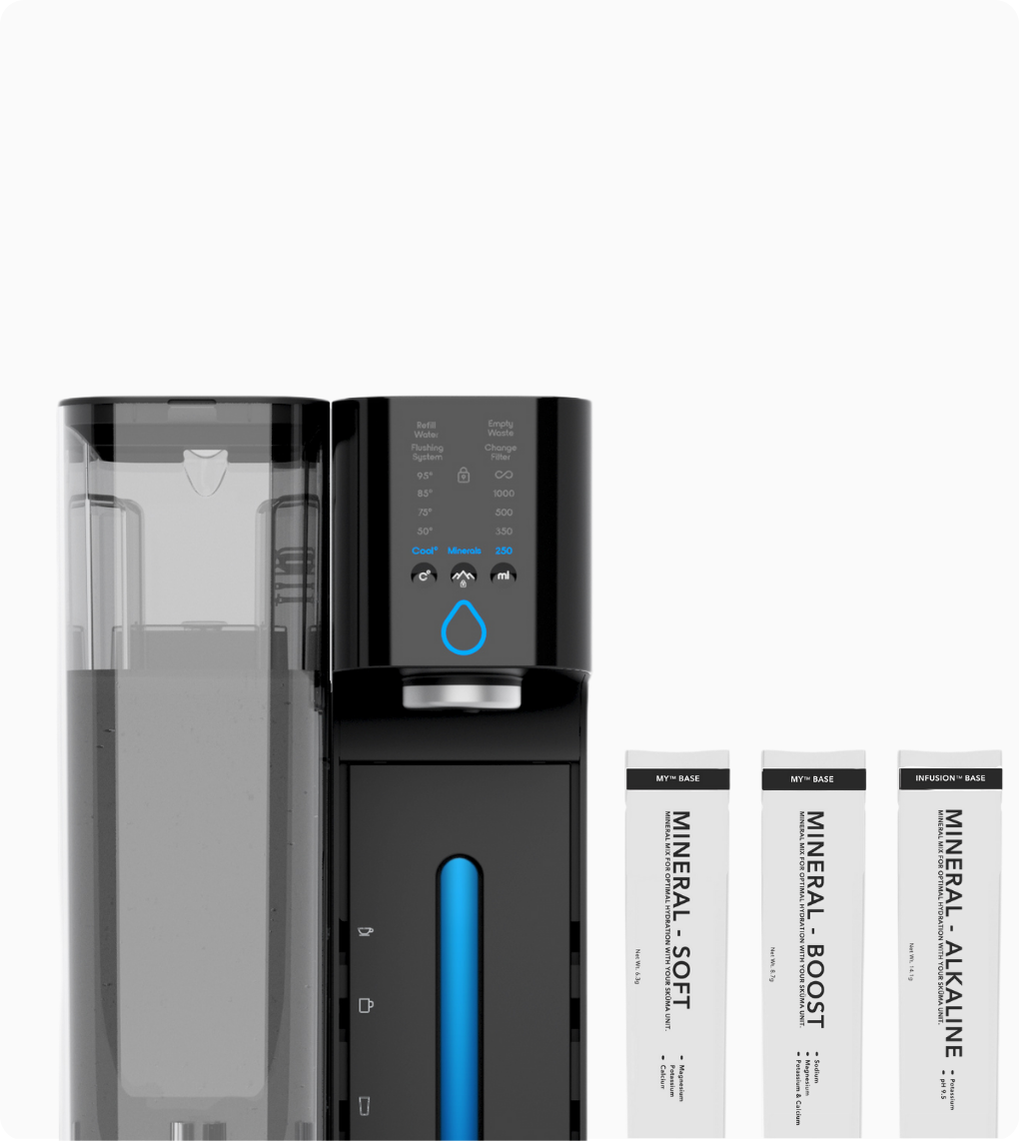
Sküma Water's MY™ Station is based on a three-stage reverse osmosis system designed to purify tap water before reintroducing minerals using MY™ Bases.
According to the performance figures provided by Sküma based on its filtration tests, the MY™ Station reduces, in particular:
- 99.9 per cent of the pesticides and metabolites tested;
- 20 PFAS tested;
- heavy metals;
- pharmaceutical residues;
- certain volatile organic compounds;
- 98 per cent of the microplastics tested.
The report provided by the brand refers to analyses carried out by an independent COFRAC-accredited laboratory. These percentages therefore correspond to the performance measured under the test conditions reported by Sküma and should not be interpreted as a guarantee that all possible contaminants will be removed in all situations.
The second stage then involves remineralising the purified water using different mineral profiles.
Mineral Soft: the mildest profile
Mineral Soft contains, in particular, magnesium, potassium and calcium, with no added sodium in its current formulation. Sküma presents it as its mildest profile, designed for daily hydration.
Mineral Plus: higher mineral content
Mineral Plus has a higher mineral concentration and contains sodium, in addition to magnesium, potassium and calcium. Sküma recommends it particularly for active individuals and for needs related to physical exertion.
If you need to limit your sodium intake for medical reasons, seek advice from your healthcare professional before changing your habits.
Mineral Alkaline: a higher pH profile
Mineral Alkaline is advertised as adding one point of pH and contains, amongst other things, magnesium, potassium and calcium.
The brand positions it as promoting digestive comfort and wellbeing. However, these benefits should not be confused with the treatment of a digestive disorder or medical condition.
Whilst breastfeeding, as with any specific medical condition, a healthcare professional remains your primary point of contact if you have any doubts.
Water, breastfeeding and exercise: should you drink more when you resume physical activity?
After giving birth, another phase gradually begins: getting back into exercise.
And when you're breastfeeding, one question often comes up: can you really exercise whilst breastfeeding?
Yes. The French National Authority for Health (HAS) emphasises that resuming physical activity or sport should not be seen as an obstacle to continuing to breastfeed.
The main priority is to tailor your return to exercise to your postnatal recovery.
Your body has just been through nine months of pregnancy and childbirth. Your pelvic floor, core muscles, posture, energy levels and, if applicable, your caesarean scar all need a tailored approach to recovery.
Hydration is part of your recovery
Resuming physical activity can increase your fluid loss, particularly if you're sweating or it's hot.
However, there's no need to drink several litres just before your session.
Instead, keep these three tips in mind:
Before your session: remember to drink regularly in the hours leading up to it.
During: keep a water bottle nearby and drink as needed, particularly when the session or the temperature causes you to sweat more.
After: continue to hydrate as normal over the following hours.
"When you return to exercise after giving birth – and even more so when you're breastfeeding – you shouldn't be chasing performance at all costs. Adapt your session to how you're feeling that day, allow yourself time to recover, and focus on the essentials: hydration, nutrition, sleep whenever possible, and listening to your body." — Caroline Rinaudo
Gently get back into exercise with Post Partum Mum
It is precisely this philosophy that guided Caroline in creating Post Partum Mum, the most popular postnatal programme on the FitMum France app.
Designed to support new mums during their first year after giving birth, the programme now comprises over 240 short, progressive sessions: breathing exercises, mobility work, postnatal Pilates, postnatal yoga, stretching, strength training and adapted cardio.
The programme progresses over the months to rebuild the foundations before gradually increasing the intensity.
The first few weeks therefore focus more on breathing, gentle mobility and reconnecting with the deep muscles. Then, postnatal Pilates, muscle strengthening and more comprehensive workouts are gradually introduced.
The programme has been designed for both vaginal and caesarean deliveries, with a progression tailored to the different stages of the postpartum period.
Above all, the aim isn't to get back to "your pre-pregnancy body" as quickly as possible. It's to gradually regain strength, mobility and confidence in your body, without adding further pressure to days that are already so full with a baby.
Fancy getting back into exercise gradually after giving birth?
With Post Partum Mum, Caroline guides you step by step with a routine already tailored for you and sessions adapted to your progress.
→ Discover Post Partum Mum and try the programme for free for 7 days
Water and breastfeeding: frequently asked questions
How much water should you drink whilst breastfeeding?
The EFSA recommends a water intake of around 700 mL more per day than that of a non-breastfeeding woman of the same age. This corresponds to an adequate total intake of around 2.7 litres per day, including food. However, actual requirements vary depending on temperature, activity levels, diet and perspiration.
Do you need to drink a lot of water to produce more milk?
No. The available data do not show that drinking more water than is required for physiological needs increases milk production.
What sort of water should you drink whilst breastfeeding?
There is no specific type of water that is essential whilst breastfeeding. The main thing is to have access to safe drinking water and to drink enough. Tap water, bottled water or filtered water can therefore all be part of your daily routine, depending on the quality of your local water supply and your personal preferences.
Is bottled water necessarily safer than tap water?
No. The presence of micro- and nanoplastics has, in particular, been documented in some bottled waters. However, this does not mean that all tap water is free from contaminants. Quality depends on many factors and must be assessed on a case-by-case basis.
Can you drink filtered water whilst breastfeeding?
Yes, provided the system is suitable for drinking water, maintained in accordance with the manufacturer's recommendations and used correctly. Some systems, such as Sküma's MY™ Station, combine reverse osmosis filtration with water remineralisation.
Is Mineral Soft suitable for use whilst breastfeeding?
Yes. It has a mild profile, with no added sodium, and is suitable for daily use. For any specific medical conditions, it is still advisable to seek the advice of a healthcare professional.
Water and breastfeeding: looking after yourself through small everyday actions
In the postnatal period, even the simplest tasks can take a back seat. Staying well-hydrated whilst breastfeeding shouldn't become an extra burden.
Simply keep a glass of water to hand, drink regularly and adjust your intake according to the heat or your activity level.
Because looking after yourself can start with a glass of water, a few minutes of movement and habits that are easy to incorporate into your daily life as a mum.
Two ways to look after yourself every day
💧 To rethink the quality of the water you drink:
Discover the MY™ Station by Sküma Water, which combines tap water purification with customisable remineralisation.
🤍 To gradually get back into exercise after having a baby:
Discover Post Partum Mum, Caroline Rinaudo's programme featuring over 240 progressive sessions to support you during your first postpartum year.
→ Try Post Partum Mum free for 7 days
Sources
- European Food Safety Authority (EFSA), Scientific Opinion on Dietary Reference Values for water, 2010.
- World Health Organisation (WHO), recommendations on exclusive breastfeeding and infant hydration.
- Haute Autorité de Santé, recommendations on breastfeeding and physical activity in the postpartum period.
- Morse J.M. et al., The Effect of Maternal Fluid Intake on Breast Milk Supply, Canadian Journal of Public Health, 1992.
- Cochrane Review, Extra fluids for breastfeeding mothers to increase milk production, 2014.
- ANSES, the CONTA-LAIT study and research on contaminants in breast milk.
- Qian N. et al., Rapid single-particle chemical imaging of nanoplastics by SRS microscopy, PNAS, 2024.
-
CNRS / CRBE Toulouse, research on microplastics in drinking water, 2025.
This article is provided for information purposes only and is not a substitute for medical advice. Any specific questions regarding your hydration, breastfeeding, your health or that of your baby should be addressed to a healthcare professional.