


Sodium has become the headline ingredient of the hydration aisle.
Tablets, powders, sticks and ready-to-drink bottles all promise to hydrate you better than water, and most of them lead with their electrolyte content, usually sodium.
Sodium genuinely matters. It has a real, non-negotiable job in keeping the body's fluid in balance.
But look at what's actually on sale and something doesn't add up: commercial hydration products range from 16 mg to over 2,000 mg of sodium per litre, a spread of more than a hundredfold, with no shared standard behind it.
So how much sodium does a drink actually need? Here's what the public-health guidelines, the sports-science evidence and the regulation itself really say, and where the category overreaches.
What does sodium actually do in the body?
Sodium isn't optional.
It's the main positively charged mineral in extracellular fluid, the water outside your cells, which includes blood plasma.
The European Food Safety Authority (EFSA) describes its role directly in its 2019 Dietary Reference Values opinion: sodium participates in "the control of the volume and systemic distribution of total body water", enables cells to take up nutrients, and works alongside potassium to generate the electrical gradients across cell membranes.
The World Health Organization's 2012 guideline puts it more plainly: sodium is "an essential nutrient necessary for maintenance of plasma volume, acid–base balance, transmission of nerve impulses and normal cell function."
Blood sodium sits in a tight band, roughly 135 to 145 mmol/L.
That tightness is the whole story: the body defends this range carefully, and moving out of it in either direction is a problem.
How much sodium do you really lose when you sweat?
Sweat carries less sodium than the blood it comes from.
The 2015 international consensus statement on exercise-associated hyponatraemia gives the range as 10 to 70 mmol/L. The 2017 position statement of the US National Athletic Trainers' Association gives sweat rates of 0.5 to 4.0 litres per hour, and resulting sodium losses of 0.2 to 7.3 g per hour.
The largest single dataset, Baker et al. (2016), measured 506 athletes. Average whole-body sweat sodium was 35.9 mmol/L, about 825 mg per litre of sweat, across a range of 18.2 to 70.8 mmol/L.
In other words, the heaviest "salty sweaters" lose roughly four times as much sodium per litre as the lightest, before you even account for how many litres each person sweats.
A caution about the numbers in circulation
Not every sweat-sodium figure is measured the same way.
Patch or local sweat sampling overestimates whole-body sweat sodium by around 25 to 100% (Baker, Sports Medicine, 2017).
A good deal of the apparent disagreement between published figures comes down to measurement method, not physiology.
What do the public-health guidelines say?
WHO recommends adults consume less than 2,000 mg of sodium per day, the equivalent of 5 g of salt.
EFSA's 2019 opinion sets 2.0 g of sodium per day as a "safe and adequate intake" for adults in the EU.
In the UK, the Scientific Advisory Committee on Nutrition (SACN) keeps a population target of 6 g of salt per day (2.4 g of sodium), which it describes as "an achievable population target and not an optimal or ideal level."
Measured intake runs well above all of these. The most recent urinary-sodium survey for England, covering adults aged 19 to 64 in 2018/19, found an average salt intake of 8.4 g per day: 40% above the 6 g target, with 69% of individual estimates above it.
The guidelines are also unusually direct about sweating.
WHO's own guideline says that in extreme heat and intense physical activity, sodium losses are "increased and appreciable; nonetheless, most individuals can replace the necessary sodium through food consumption, without dietary alterations, supplements or specially formulated products."
Most of us already eat more sodium than recommended, and the guidelines don't carve out an exemption for people who exercise.
Can drinking too much water be dangerous?
Yes, in a specific context.
Exercise-associated hyponatraemia (EAH) is defined as blood sodium below 135 mmol/L during or up to 24 hours after physical activity. In endurance events, it isn't rare.
Almond et al. (New England Journal of Medicine, 2005) found that 13% of 488 Boston Marathon runners tested below 135 mmol/L. Speedy et al. (1999) found 18% of 330 New Zealand Ironman finishers affected. Hoffman et al. (2013) found 15.1% across 669 runners in 161 km ultramarathons, with wide variation from year to year.
Why sodium in your bottle doesn't solve it
This is the part that tends to get left out of hydration marketing.
The 2015 consensus statement identifies the main cause as "the overconsumption of hypotonic fluids", and its list of risk factors names sports drinks alongside water.
Its position on whether electrolyte drinks prevent the problem is unambiguous: "sodium containing sports drinks, which are hypotonic, will not prevent EAH in athletes who overdrink during exercise, as all sports drinks have a significantly lower [Na+] (10–38 mmol/L) than serum (~140 mmol/L)."
Almond's Boston data supports this. Weight gain during the race and finishing times above four hours were independent risk factors. Fluid composition was not: it made no measurable difference whether runners drank water or sports drink.
Hoffman's ultramarathon data adds a complication worth stating rather than smoothing over: in that group, EAH was more common with dehydration than with overhydration, and the authors concluded that both excessive sodium supplementation and drinking well beyond thirst are ill-advised.
The risk is real, but it's governed by how much you drink, not by what's dissolved in it. The consensus advice is to drink to thirst rather than to a schedule.
How much sodium is actually in hydration drinks?
Here are the manufacturers' own published figures, converted to sodium per litre as each product is directed to be mixed:
| Product | Sodium per litre, as directed |
|---|---|
| Prime Hydration (UK, ready-to-drink) | 16 mg/L |
| High5 ZERO tablet | ~333 mg/L |
| Gatorade Thirst Quencher (US) | ~450 mg/L |
| Lucozade Sport (UK) | 500 mg/L |
| Powerade (UK) | ~500 mg/L |
| Nuun Sport tablet | ~630 mg/L |
| SiS GO Hydro tablet | ~690 mg/L |
| Precision Fuel & Hydration PH 250 to PH 1500 | 250–1,500 mg/L |
| LMNT Recharge (1,000 mg stick) | ~1,060–2,110 mg/L, depending on dilution |
| WHO/UNICEF reduced-osmolarity ORS | 1,725 mg/L (75 mmol/L) |
At the other end of the scale, Highland Spring publishes 5.6 mg/L of sodium, Evian 6.5 mg/L and Volvic 12 mg/L.
UK tap water varies by supply zone. Thames Water's Oxford Central zone reported a 2025 average of 26 mg/L, while one Affinity Water zone in St Albans ranged from 15.1 to 162 mg/L within a single year's sampling. There's no meaningful single figure for "UK tap water sodium"; the honest answer is a range.
Two things stand out.
First, the category isn't one thing. LMNT at its stronger dilution carries more than a hundred times the sodium of Prime, and more than the WHO oral rehydration formula designed to treat dehydration from acute diarrhoea.
Second, the mainstream isotonic drinks cluster around 450 to 700 mg/L, squarely in the middle of the measured sweat-sodium range rather than above it.
What is a hydration drink legally allowed to claim?
In the UK and EU, there is no authorised health claim for sodium as a hydration ingredient on its own.
The only authorised claims in this space apply to carbohydrate-electrolyte solutions, under Commission Regulation (EU) No 432/2012: that they "contribute to the maintenance of endurance performance during prolonged endurance exercise" and "enhance the absorption of water during physical exercise."
Both come with strict conditions of use. The drink must provide 80 to 350 kcal per litre from carbohydrates, with at least 75% of that energy from high-glycaemic carbohydrates, between 20 mmol/L (460 mg/L) and 50 mmol/L (1,150 mg/L) of sodium, and an osmolality of 200 to 330 mOsm/kg.
Two consequences follow.
The 460 mg/L figure is a floor and the 1,150 mg/L figure is a ceiling: the regulation defines a window, not a minimum to beat.
And because of the carbohydrate condition, a zero-sugar electrolyte tablet or powder cannot lawfully carry either claim, however much sodium it contains.
Separately, a "low sodium" claim requires no more than 0.12 g of sodium per 100 ml (Regulation (EC) No 1924/2006), and a natural mineral water can only be described as "suitable for a low-sodium diet" below 20 mg/L (Directive 2009/54/EC).
Does more sodium mean better hydration?
This is where the evidence is thinnest, and it's worth saying so plainly.
The Beverage Hydration Index study (Maughan et al., American Journal of Clinical Nutrition, 2016) is the paper most often used to argue that water alone under-hydrates.
What it actually found, in 72 men drinking one litre over 30 minutes: only oral rehydration solution, full-fat milk and skimmed milk were retained significantly better than water. The sports drink tested was not. Its retention was statistically indistinguishable from plain water, alongside cola, tea, coffee, orange juice and sparkling water.
An independent replication (Sollanek et al., 2018, 40 men and women) reached the same conclusion. Millard-Stafford et al. (2021) found that electrolytes alone, at sports-drink concentrations, did not consistently improve retention compared with water.
Two limitations belong with those results. The retention benefit appears at roughly oral-rehydration strength, around 55 mmol/L and above, not at typical sports-drink strength. And the original study was funded by the European Hydration Institute, whose scientific advisory board the lead author chaired, as the paper itself discloses.
On performance, a 2025 review by McCubbin in Performance Nutrition is direct: "No studies to date have shown a beneficial effect of sodium replacement on performance, independent of fluid replacement."
There is a genuine live disagreement here. The International Society of Sports Nutrition's 2019 position stand on ultramarathons recommends more than 575 mg/L, and 300 to 600 mg per hour in the heat, but places that recommendation in its own lowest evidence tier. The Wilderness Medical Society's 2019 guidance grades avoiding overdrinking more strongly than sodium supplementation.
Sodium has a defensible role during sustained, heavy sweat losses. The broader idea that more sodium equals better hydration isn't supported by the evidence.
What isn't known yet?
Some honest gaps, because withheld certainty is worth more here than a confident round number.
The most-cited authority in the field is out of date. The American College of Sports Medicine's Exercise and Fluid Replacement position stand dates from 2007, and the widely circulated "0.5–0.7 g of sodium per litre" figure attributed to it actually comes from the 1996 edition.
There's no UK urinary-sodium survey more recent than the 2018/19 England data. Scotland's last was in 2014, Northern Ireland's in 2015.
Your own sweat-sodium concentration can't be inferred from any general figure. The measured range spans roughly fourfold, and no consumer-accessible method reliably identifies where a given person sits.
And no published study has isolated a performance benefit from sodium replacement independent of the fluid it's dissolved in.
Where does Sküma Water fit in?
If the evidence points anywhere, it's towards treating minerals as a deliberate choice rather than a default.
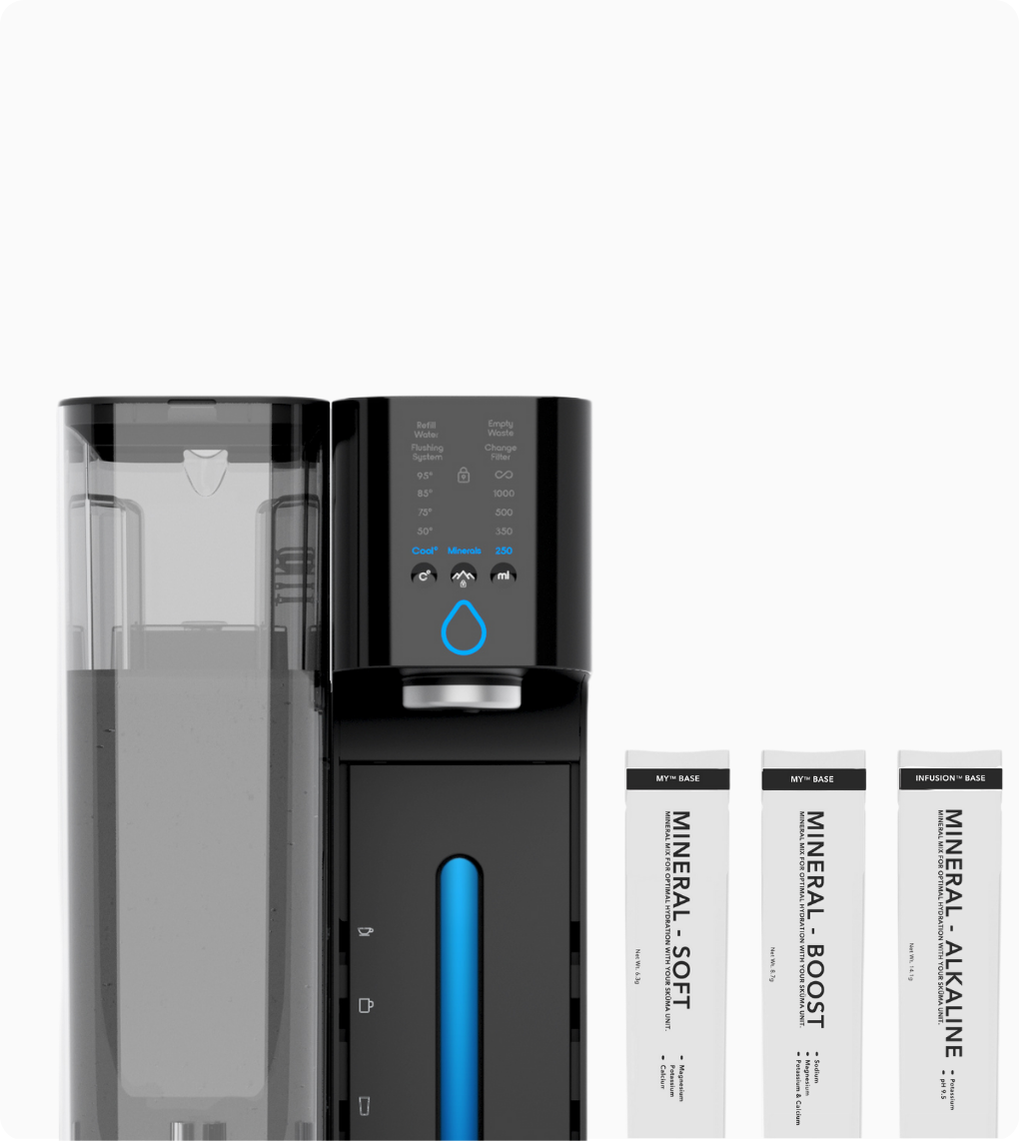
That's the logic behind Sküma's HYDRATION.melisse™ Liquid Electrolyte Booster: an electrolyte blend of sodium, magnesium and potassium, formulated without the excess sodium found in many conventional hydration drinks, and designed to be added to filtered water rather than sold as a pre-mixed sugary drink.
Its second component is lemon balm (Melissa officinalis), which gives the product its natural mint-lemon flavour.
Added to water from a Sküma® MY™ Station, it puts the mineral content of what you drink back in your hands, which, in a category that spans 16 to over 2,000 mg of sodium per litre, is the part worth controlling.
What to remember
Sodium is essential, and your body regulates it tightly.
Most adults in the UK already eat well above the recommended amount, and WHO considers food sufficient to replace sweat losses for most people, even in the heat.
The real hydration risk during long endurance events is drinking too much, and sports drinks don't protect against it.
Hydration products range from 16 to over 2,000 mg of sodium per litre, and the only regulated hydration claims apply to a window of 460 to 1,150 mg/L, with carbohydrates.
For everyday hydration, the evidence points to water, drunk to thirst, with sodium as a targeted tool for sustained heavy sweating rather than a daily requirement.
FAQ: Sodium and hydration drinks
Do I need sodium in my water for everyday hydration?
For ordinary daily drinking, the public-health evidence points the other way. WHO recommends adults stay below 2,000 mg of sodium per day, average intake in England was 8.4 g of salt per day in 2018/19 against a 6 g target, and WHO states that most people can replace sweat losses through food without specially formulated products.
How much sodium do we lose in sweat?
Sweat typically contains 10 to 70 mmol/L of sodium. In the largest dataset, of 506 athletes, the average was about 825 mg per litre of sweat, with the saltiest sweaters losing roughly four times as much per litre as the least salty.
How much sodium is in a typical sports drink?
UK isotonic drinks cluster around 450 to 700 mg of sodium per litre; Lucozade Sport and Powerade both publish figures of about 500 mg/L. The wider category runs from around 16 mg/L (Prime Hydration UK) to over 2,000 mg/L (LMNT at its stronger dilution).
Can drinking too much plain water be dangerous?
Yes, in a specific context. Exercise-associated hyponatraemia affected 13% of tested runners at the Boston Marathon and 15.1% of runners in 161 km ultramarathons. The cause is drinking too much, and the 2015 consensus statement is clear that sodium-containing sports drinks don't prevent it. Drinking to thirst does.
Do electrolyte drinks hydrate better than water?
In controlled studies, a standard sports drink was retained no better than plain water. Only oral rehydration solution and milk performed better, and the benefit appears at sodium levels far above typical sports drinks.
Can a zero-sugar electrolyte tablet claim to improve hydration?
Not in the UK or EU. The only authorised hydration claims apply to carbohydrate-electrolyte solutions containing 460 to 1,150 mg/L of sodium and 80 to 350 kcal per litre from carbohydrates.
How much sodium is in UK tap water?
It depends on where you live. One Thames Water zone reported a 2025 average of 26 mg/L, while one Affinity Water zone ranged from 15.1 to 162 mg/L in a single year. Your water company publishes the figures for your supply zone.
Who should be cautious about general hydration advice?
Anyone with a medical condition affecting fluid or sodium balance, such as heart, kidney or blood pressure conditions, should follow the advice of their doctor rather than general guidance.
Sources: World Health Organization, Guideline: Sodium intake for adults and children (2012); EFSA, Dietary Reference Values for sodium (2019); Hew-Butler et al., Statement of the Third International Exercise-Associated Hyponatremia Consensus Development Conference (2015); Baker et al. (2016); Almond et al., NEJM (2005); Maughan et al., AJCN (2016); McCubbin, Performance Nutrition (2025); Commission Regulation (EU) No 432/2012.
Note: this article is for information purposes and does not replace medical advice. Any specific question about your sodium intake or hydration needs should be directed to a healthcare professional.